

ZenX
Internal Operating System for Human Consciousness
Something's happening inside you right now.
Not really a thought. Not reflection either.
More like a conversation you didn't agree to have.
Two voices.
One asks.
The other doesn't even let the question finish.
You call it thinking. Most people do.
But if you look closely... it's not that clean.
Thinking usually moves somewhere.
This doesn't. It splits.
Part of you actually wants to see. Clearly.
Even if that gets uncomfortable.
And another part... just wants things to stay as they are.
Even if they're wrong.
That's where it starts.
Not the conflict. That's normal.
The problem is you don't hear two voices.
You hear one.
You call it "me."
So it feels like you're choosing.
But if you slow it down for a second...
you might notice something slightly disturbing:
the choice is already made before you arrive.
Something inside you moves first...
then hands you the explanation.
This system doesn't give you new ideas.
It doesn't fix you.
It doesn't upgrade you.
It does something smaller.
And much more uncomfortable.
It lets you catch the moment...
right before you say: "this is me."
And asks one thing:
who's actually talking right now?

What This Is
There is a conversation happening inside you right now.
It has been happening since before you could speak since before you had language to describe what was being said. Two forces, talking past each other. One trying to see clearly. One trying to stay comfortable. One asking questions. One building walls.
You call this conversation "thinking."
But it's not one thing. It's a dialogue. And the quality of your life—the decisions you make, the relationships you maintain, the clarity you can access when it matters—depends on which voice you're listening to.
This system maps that conversation.
Not metaphorically. Structurally. The way a mechanic doesn't just say "your car is broken" but maps which system is failing—engine, transmission, fuel—and knows what to do with each.
Nine voices. Nine rooms in your internal house.
You've been in all of them. You will be in all of them again. The work isn't to eliminate them it's to recognize which room you're standing in, so you can decide whether to stay.
The Two Speakers
Musa
: the analytical faculty. The part that asks why. That examines. That refuses to accept the story just because it's familiar. The one who looks at the thing everyone agrees is true and asks: is it?
Musa isn't peaceful. He's not wise. He's often irritating to others and to himself. He asks questions that make everyone uncomfortable, including his own mind. He doesn't have answers. He has a process. He keeps working until the picture clarifies.
The Ego
("She") everything else. The voice that talks faster than Musa can think. The collection of impulses, fears, wounds, stories, and habits that make up what you call "I."
The Ego is not evil. It's not stupid. It's trying to survive in its own way—and it's been running the operation long enough that it knows every trick. It has nine faces, and it wears them all.
The Nine Rooms
Azar: The Programming
What you learned before you had the ability to question it. What your family believed, your culture assumed, your first teachers installed. The operating system you didn't choose but now run on. Most of what you call "reality" is Azar.
You know you're inside Azar when you can't explain why you believe what you believe. When the belief just is like gravity, like weather, like the way things have always been.

Abu Lahab: The Fire
Anger is not one thing. It's a system: the trigger, the justification, and the rehearsal. Abu Lahab is the fire. His wife is the wood—she carries the narrative that fuels the flame.
You know you're inside Abu Lahab when you're replaying a conversation for the hundredth time. When you have new lines for an old battle. When the heat has passed but you're still adding fuel.

The Samiri: The Materialization
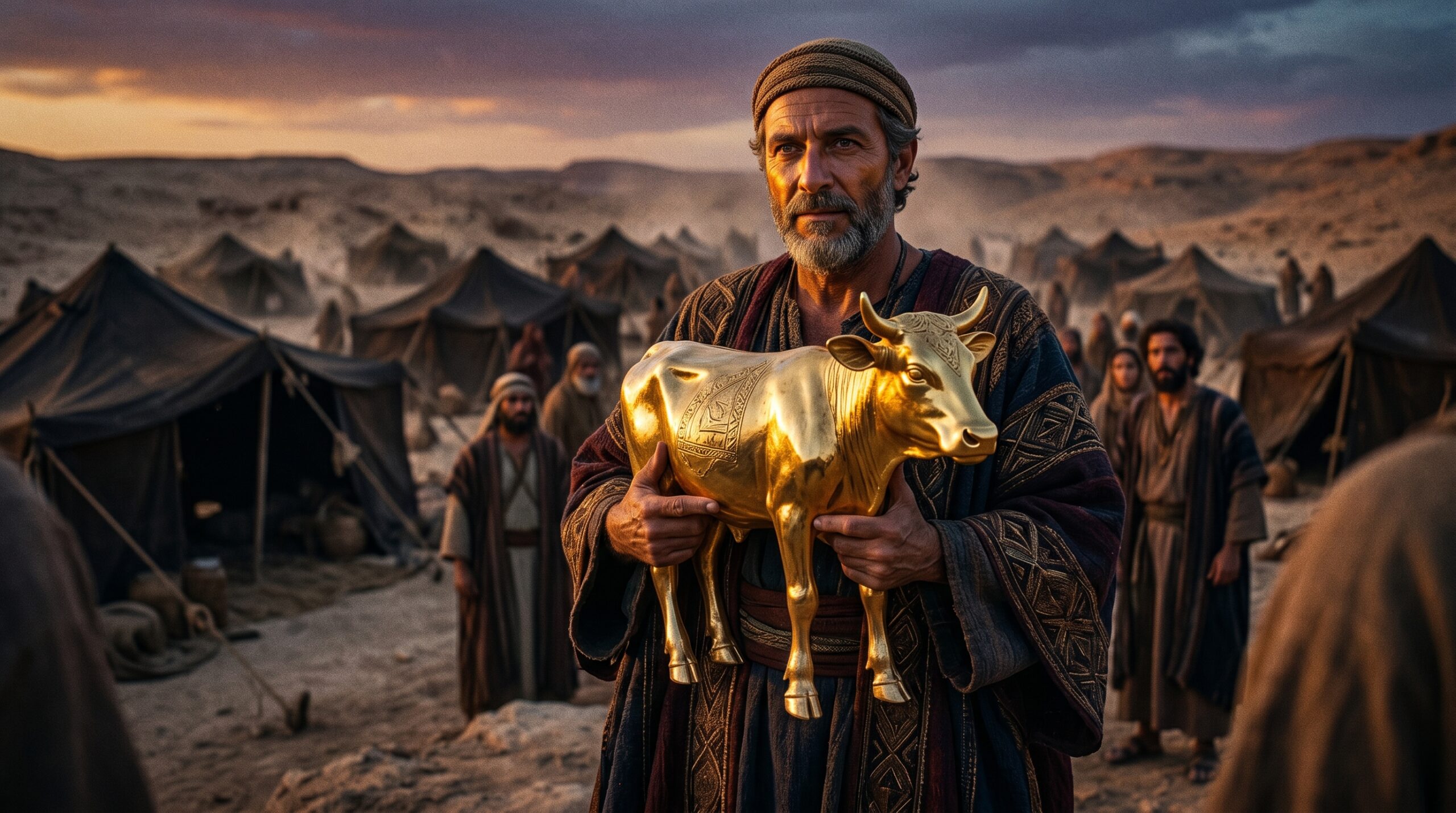
The part of you that cannot hold the abstract so it makes idols. Takes a living idea and turns it into a fixed thing. Makes a god you can carry instead of a truth you have to follow.
You know you're inside the Samiri when you have conclusions that feel too solid. When your beliefs have edges that can't be touched. When you're defending something, you built instead of engaging with something you found.
Korah: The Ornament
Knowledge worn as jewelry. Information collected and displayed instead of understood and used. The difference between knowing things and being intelligent and how easy it is to confuse them.
You know you're inside Korah when learning feels like acquiring rather than discovering. When you have more to prove than to question. When the collection is the point.
Pharaoh: The Tower
The self that believes it has arrived. That constructs the architecture of grandiosity the ideology, the justification, the system that explains why this particular center is the correct one.
You know you're inside Pharaoh when other people's perspectives feel less real than yours. When feedback lands as attack. When your position has become more important than your growth.

Potiphar's Wife: The Mirror
The one who shows you what you actually are not what you've arranged, not what you've performed, not what you've earned. The mirror that refuses to collaborate with your self-image.
You know you're avoiding her when you explain your behavior in ways that make you look better. When someone else's mistake is clearer than your own. When you've been not-looking at something for so long it's become invisible.

Noah's Wife / Lot's Wife: The Weight
The part that can't let go. That stays in the old story even when the new story is available. That looks back instead of forward because the unknown is terrifying and the familiar has weight.
You know you're inside this one when you can see what's being offered but can't move toward it. When you're maintaining a version of yourself that's run its course. When the boat is here and you're still looking at what you know.

Haman: The Architect
The system building machinery. The part that takes fears and builds walls, takes wounds and makes foundations, takes your need for certainty and designs the cage around you then calls it home.
You know Haman is working when you hear an idea and immediately calculate how it fits your structure. When challenges feel like threats. When the architecture has more value than the purpose it was meant to serve.

What This Is Not
This is not religion.
The characters are not historical figures being interpreted. They are psychological patterns being mapped. The Quran, the Bible, the myths—they are diagnostic tools, not devotional texts.
This is not spiritual advice.
We're not talking about enlightenment or peace or becoming a better person. We're talking about seeing clearly. About recognizing the room you're in. About the ongoing, unglamorous work of paying attention to what's actually happening inside you.
This is not a solution.
You will not finish this. You will not integrate all nine rooms and arrive somewhere finished. This is a system for orientation—a map that helps you navigate the terrain you're already standing in.
The work doesn't end. It gets more precise.
How to Use This
Each episode stands alone.
If you're in the middle of a conversation where anger got triggered read Abu Lahab. If you find yourself defending something you built instead of questioning it read the Samiri.
But also: read them in order.
Azar is first because it's the foundation. Most of what you call "you" is programming you inherited before you could choose. Abu Lahab comes next because anger is the most immediate response to threat. The Samiri, then Korah, then Pharaoh—each one building on the previous, each one more subtle than the last.
Potiphar's Wife is in the middle because she forces you to look. Noah's Wife comes after because looking often reveals what you can't let go of. Haman comes last because he's the one who built all the rooms and who will keep building them unless you see him.
The Real Ask
You already know this stuff.
Not as concepts—you know it as experience. You've been inside Abu Lahab's fire. You've met the Samiri's calf. You've felt Pharaoh's tower and Potiphar's mirror.
The difference between suffering in a room and recognizing the room is this: recognition.
This system gives you the vocabulary. Not to become someone new but to see the someone you've been, more clearly than before.
That's it. That's the whole thing.
The door is open. The rooms are mapped.
Walk through.
ZenX
Internal Operating System for Human Consciousness