 IMRA'AT AL-AZIZ · Section Four
Section Four
The Gap Between Seduction and Capitulation
The narrowest, most intimate distance in the architecture
The distance between the first sentence of reinterpretation and the moment when the clarity is no longer available.

What the Gap Actually Is
Narrower than the gaps in the other rooms
In the previous rooms,
the gap was between the signal and the verdict,
the discomfort and the substitute.
In this room, the gap is different.
It is narrower.
More intimate.
More easily missed.
It is the distance between the first sentence of reinterpretation
and the moment when the clarity is no longer available.
That first sentence is the gap.
Not the endpoint of the negotiation,
when the decision has already been dissolved.
Not the beginning of the discomfort,
when something real is being asked.
The moment the first internal voice arrives
to reframe what the decision means.
Before that sentence: the clarity is present.
After the negotiation completes: the clarity is gone.
The gap lives in the space between them.
Why the Gap Is So Narrow Here
She operates in the register of meaning
Abu Lahab's sequence moves from signal to verdict.
The gap there has some physicality to it,
a tightening, a sentence forming,
something the body registers.
The Samiri's gap is slightly more cognitive,
the moment between discomfort and the reach for substitute.
Imra'at Al-Aziz works at a different level.
She operates in the register of meaning.
Not in the body primarily.
Not in obvious desire.
In the layer where words produce
the interpretation of what something means,
and therefore what the appropriate response is.
The gap here is:
the fraction of time between
the decision that was present
and the reinterpretation that makes a different decision feel equally valid.
It is easy to miss.
Because the reinterpretation does not announce itself as a reinterpretation.
It announces itself as a thought.
A reasonable, relevant, well-timed thought.

The Three Signals
Not signals of the negotiation. Signals that the gap has opened.
These are not signals of the negotiation.
They are signals that the gap has opened,
that the first sentence of reinterpretation has arrived,
and the seduction's architecture has begun to activate.
Signal One: The Decision Becomes a Question
Making the decided into the undecided
Something was decided.
And then, without new information arriving,
the decision is now a question.
- "Is this really what I want to do?"
- "Have I fully thought this through?"
- "Maybe I should revisit this."
The decision has not been challenged by evidence.
It has been moved from the category of decision
into the category of ongoing deliberation.
This is the seduction's first move:
making the decided into the undecided,
not through argument,
but through reclassification.
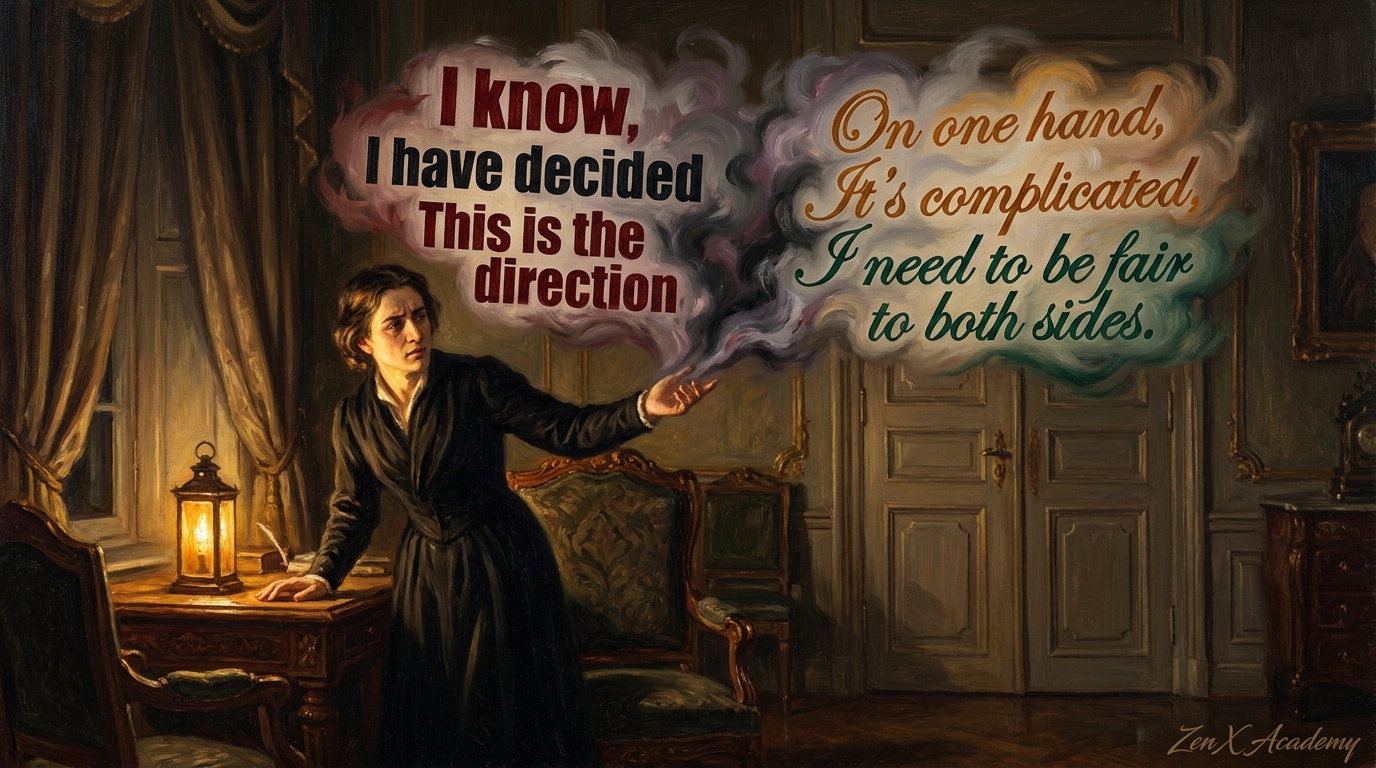
Signal Two: The Language Shifts
Complexity elevated from context to center
Before the gap opened,
the clarity had a specific language.
Direct. Owned. First-person.
- "I know what I need to do."
- "I have decided."
- "This is the direction."
After the first sentence of reinterpretation,
the language shifts.
It becomes more considered.
More nuanced.
More carefully balanced between competing perspectives.
- "On one hand..."
- "It's complicated because..."
- "I need to be fair to both sides of this..."
The complexity is not new.
The complexity was present before the gap opened.
What has changed is that the complexity
has been elevated from context to center,
so that navigating the complexity
temporarily replaces actually deciding.
Signal Three: The Clarity Feels Premature
The most important one to recognize
Before the gap opened,
the clarity felt earned.
After the first sentence of reinterpretation,
it begins to feel, barely, subtly,
like it might have been hasty.
- "I was probably reacting rather than thinking."
- "That clarity might have been impulsive."
- "I should give this more time before I commit."
The clarity that a moment ago felt true
now has a slight shadow of doubt on it.
Not from evidence that disproves it,
but from the suggestion that clarity itself
might be a form of rushing.
Why This Signal Matters
What Can Be Noticed in the Gap
You are not trying to stop the seduction
You are not trying to stop the seduction in the gap.
You are trying to notice one thing:
That the clarity was present before this sentence arrived.
Not to defend the clarity.
Not to argue for it.
Not to insist it was right.
Simply to register:
"Something was clear here.
And now a conversation has begun.
The conversation did not bring new information.
It brought reframing."
That registration, even imperfect, even partial,
is the interruption.
Because the seduction's architecture requires
that the reinterpretation not be named as reinterpretation.
The moment it is named,
the gap becomes visible.
"And She Closed the Doors"
When the system becomes fully self-contained
This phrase from the account is not incidental.
It describes a specific psychological moment:
the moment the internal system becomes fully self-contained,
closed to external reference,
generating its own evidence,
adjudicating its own arguments,
with the seduction's voice as the primary speaker.
When this happens in your inner life,
when the decision is no longer being held in contact with
what you know clearly outside the system,
the doors have been closed.
The Signal That the Doors Are Closing
The Yusuf Response
The refusal to enter the house
That refusal is not resistance.
It is not the declaration of someone fighting desire.
It is the refusal to enter the house.
"I am not sitting down at this table.
This negotiation is not one I am beginning."
Not because the arguments are wrong.
Sometimes they are right.
But because the gateway to the seduction's architecture
is always the first sentence of reinterpretation.
The moment you engage with it seriously,
the moment you begin to discuss whether the clarity was real,
the doors are already partly closed.
That refusal operates before that moment.
Not as moral fortitude.
As the recognition that the conversation itself
is the house,
and that entering the conversation
is entering the house.
Exercise Four: The 24-Hour Seduction Watch
Watching for the first sentence
This exercise runs for one day.
You are not trying to stop the negotiation.
You are watching for the gap.
Specifically: the first sentence.
During the day,
each time you notice a decision, direction, or clarity
beginning to become a question,
pause.
Not to defend the clarity.
Not to argue for it.
Ask only:
"Was this clear before this sentence arrived?"
If yes, note it.
Not in analysis.
In one word:
"Reframe."
That is the entire practice.
At the End of the Day
One sentence, no analysis
Write one sentence:
"Today, the first sentence of reinterpretation arrived when:"
Not what it said.
When it arrived.
In relation to what clarity.
What This Practice Produces
The specific capacity this room is building
The ability to recognize the first sentence,
not after the negotiation has completed
but as it begins,
is the specific capacity this room is building.
Not the refusal to think.
Not the rejection of complexity.
The ability to distinguish between:
A thought that is examining the decision.
And
A sentence that is entering the negotiation with it.
One is thinking.
The other is the house closing its doors.
The gap is the distance between them.
And it is visible,
once you know what the first sentence sounds like.
Section Five moves to what the seduction is protecting, what the house was built to guard, and why knowing this changes the work.