 HAMAN · Section Two
Section Two
Living Inside the Tower
Haman in daily life
There is a specific feeling that tells you you are inside a tower rather than examining one. Not anger. Not defensiveness. The sense that the question itself is wrong.
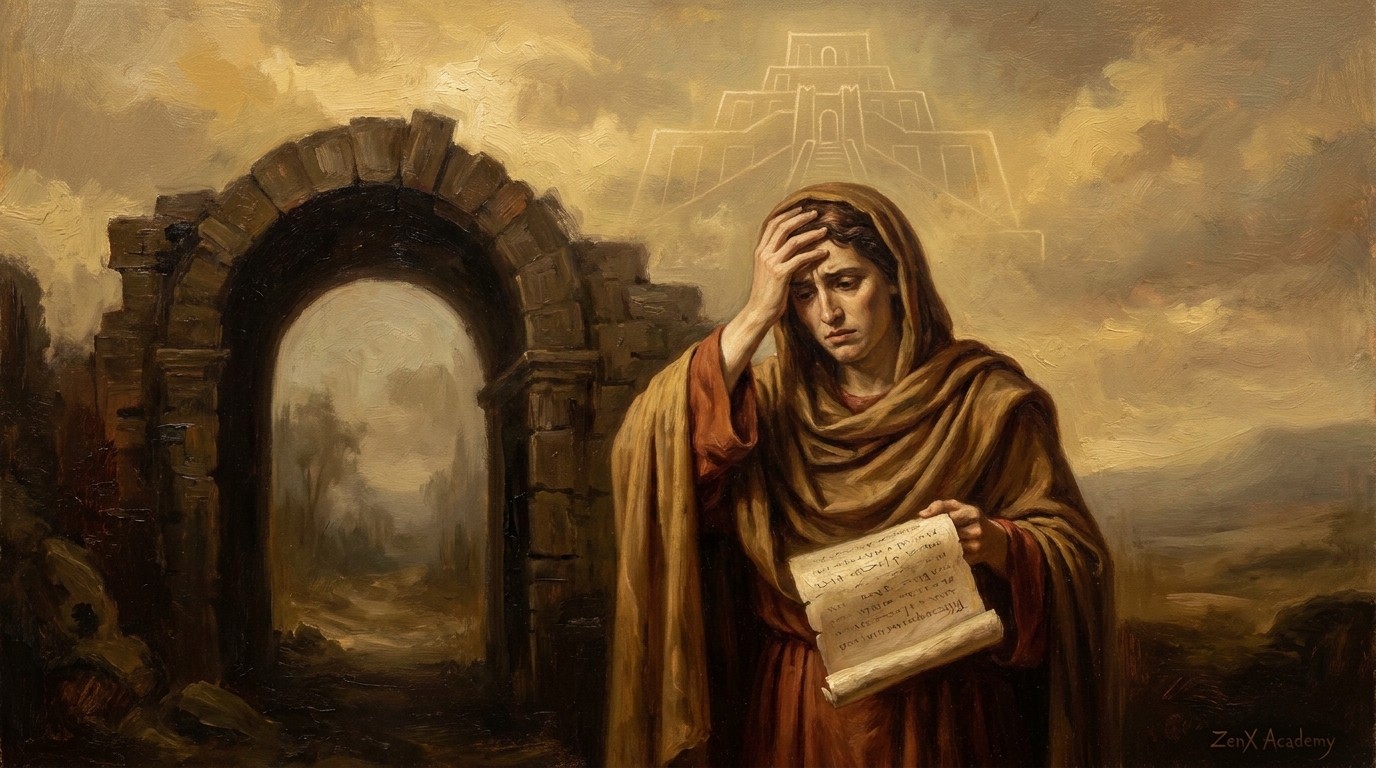
Before the Locations
The specific feeling that tells you you are inside a tower
There is a specific feeling that tells you
you are inside a tower rather than examining one.
It is not anger exactly.
Not defensiveness exactly.
Not the heat of Abu Lahab
or the negotiation of Imra'at Al-Aziz.
It is something more like:
An instinctive sense that the question itself is wrong.
Not that the question has a bad answer.
Not that the question is difficult.
That the question should not be asked.
That the person asking it has misunderstood something fundamental.
That proceeding with the answer would require entering territory
that is somehow not available for this kind of entry.
The feeling arrives before thought.
Before you have evaluated the question.
Before you have considered whether it might be valid.
Something closes.
Something draws back.
And from somewhere, almost automatically:
- "That's not really what this is about."
- "You'd have to understand the context."
- "It's more complicated than that."
- "I don't think you're asking the right question."
These are not answers.
They are the architecture doing its work,
redirecting the approach to the foundation
before examination can begin.
This is what living inside the tower feels like.
The Difference From Abu Lahab
Haman does not argue. He redirects.
Abu Lahab defends a position.
When you challenge him,
there is heat, certainty, escalating investment.
He will argue.
He will cite evidence.
He will become more sure as the challenge intensifies.
Haman does not argue.
When you approach his tower's foundation,
something different happens:
The conversation shifts register.
From: examination of content
To: examination of the questioner.
- "Why are you asking this?"
- "What are you trying to prove?"
- "Do you realize what you're implying?"
- "This feels like an attack, not a question."
The question about the foundation
has been redirected into a question about the person asking.
Not because Haman is dishonest.
Because inside the tower,
an approach to the foundation
genuinely feels like aggression.
That feeling is Haman's primary protection mechanism.
It is not manufactured. It is built into the architecture.

The Five Towers
Where Haman's architecture operates most actively in daily life
The Identity Tower
Your sense of who you are was built inside a framework
Your sense of who you are
was built, at some point, inside a framework.
A tradition. A community. A practice. A belief system.
A way of understanding what matters, what you are for,
what gives your life its shape.
This is the tower that holds the self together.
And Haman has been very busy here.
Because this tower has been inflated with the most powerful kindling:
Your own experience of it being real.
The moments when the framework was true.
The times when it gave you something nothing else could.
The people you love who share it.
The version of yourself you became inside it.
All of this is genuine.
All of this was real clay, genuinely worked.
And from it, Haman built the specific structure:
The framework through which you understand yourself
cannot be examined at the foundation
without you experiencing the examination as a threat to who you are.
The Signal
The Belonging Tower
To question the framework is to question the belonging
There are people you love, or have loved,
or belong to in ways that have shaped who you are.
The family. The community. The movement. The tradition. The people.
And inside the shared life with these people,
frameworks were built:
ways of seeing the world,
shared narratives about history and identity and what matters,
inherited understandings about what is real and what is right.
These frameworks were not just adopted.
They were received through the medium of belonging.
Through presence. Through shared life. Through the faces of people who matter.
And this is the clay Haman worked most carefully.
Because now,
to question the framework
is to question the belonging.
Not logically.
Not as a stated consequence.
But in the feeling.
The question that touches the foundation of the shared framework
lands as:
- "Are you questioning us?"
- "Is this how you see what we have built?"
- "Do you know what it would mean for this to be examined the way you are suggesting?"
The examination has been made structurally inseparable from betrayal.
Not by anyone's design.
By the way Haman built the tower,
with real belonging as the clay.
The Suffering Tower
The framework built around what cannot be relived without meaning
Something happened.
Something that was painful enough, significant enough,
to become a reference point in the story of your life.
And around that event, slowly, not consciously,
a framework built itself.
A way of understanding what happened and why.
Who was responsible. What it means. What it demands.
And this framework cannot be examined at its foundation
for a specific reason that Haman knows well:
If the framework is wrong, the suffering might be without the meaning you gave it.
Not that the suffering was not real.
Not that the injustice was not real.
But the specific meaning, the tower built from it,
might be a construction rather than the truth about it.
And the examination of that possibility
feels like it would require the suffering to be endured again,
this time without a framework that makes it intelligible.
So the foundation stays unexamined.
Not from cowardice.
Because Haman built the tower
from what was most genuinely irreplaceable.
The Signal
Examining the framework built around suffering
is not the same as denying the suffering itself.
The suffering was real.
The injustice may have been real.
The examination is of what was constructed around it,
not of whether it happened or whether it mattered.
The Sacred Authority Tower
Questions about their conclusions are possible. Questions about their authority to conclude are not.
There are voices you listen to differently.
Not because you chose to trust them more than others.
Because the framework that grew around their authority
has been inflated to a specific height:
Questions about their conclusions are still possible.
Questions about their authority to conclude are not.
Not a formal prohibition.
A structural one.
The teacher whose framework you learned from.
The text whose interpretation organized your understanding.
The tradition whose authority provided the ground.
These are real. Their contribution was real.
The authority was often earned.
And Haman took it and built from it
a structure that now makes questioning the authority
feel like ingratitude, arrogance, or category error.
- "You can't judge this without understanding the full context."
- "That criticism misses what they were actually saying."
- "You'd have to have spent years with this material to question it that way."
Each of these can be legitimate.
Each can also be the tower redirecting the question.
The Signal
The Achievement Tower
Built from what you cannot afford to lose
You built something.
Or you gave significant time, energy, and identity
to something that was being built.
A project. A career. An institution. A belief system. A practice.
And now, because so much was given,
examining the foundation of what was built
would require examining whether what was given was well-given.
Not whether the work was valuable.
Whether the premises it was built on
deserve the same examination you apply elsewhere.
Haman built here from the most powerful clay of all:
Your own irreversible investment.
The examination of the foundation
now carries the implicit threat:
"All of that might have been built on something that doesn't hold."
And this is not an abstract fear.
It is the specific cost that makes the examination feel different from other examinations.
So the foundation stays unexamined.
Not from laziness.
Because the tower was built from what you cannot afford to lose.

What All Five Towers Share
Why the towers are so hard to see from inside
In each of them:
- The clay was genuine.
- The belonging or suffering or investment or love was real.
- The authority was often earned.
Haman does not work with falsehood.
He works with what is most real,
and builds from it a structure that cannot be examined at the foundation
without threatening what was most genuinely given.
And this is why the towers are so hard to see from inside.
Not because you are foolish.
Not because you are weak.
Because the tower was built from what you love.
The Specific Anger
The tower's immune response
When someone approaches the foundation of one of these towers,
not the conclusions, not the practices, not the applications,
but the foundation itself,
a specific kind of response appears.
Different from Abu Lahab's heat.
Different from Fir'aun's escalating certainty.
Something more like:
- A drawing back.
- A sense that something inappropriate is happening.
- A feeling that the question itself requires explanation: "Why are you asking this?"
- A defensiveness that feels righteous rather than strategic.
- A sense that the questioner is not being respectful of something that deserves respect.
This is the tower's immune response.
Not fabricated.
Built into the architecture.
When this response appears, when examination feels like transgression, Haman is at work.
Before moving to the locations, a necessary clarification.
Not every resisted question points to a tower.
Some questions are confused.
Some are manipulative.
Some are built on assumptions that deserve examination before the answer does.
Some approach a topic in ways that genuinely require context before they can be usefully engaged.
The signal is not resistance itself.
The signal appears when the legitimacy of the question itself
becomes harder to examine than the foundation the question approaches.
Not: "This question is wrong."
But: "This question should not be asked here, and I cannot fully examine why."

Exercise Two: The Tower From Inside
Recognizing the architecture you have been living inside
Choose the tower from the five locations
that produced the most recognition,
the one where the signal appeared most clearly.
Write three things, honestly:
"The question about this tower's foundation that I consistently do not ask is:"
"When this foundation is approached, what appears in me, physically, emotionally, before I have time to think?"
"The sentence I most reliably use to redirect the approach is:"
Section Three is the assessment: the mirror placed in front of the specific architecture you have just been inside.