The Weight of What You Kept
Noah's Wife and Lot's Wife On the loyalty that keeps you standingon a shore that is going underwater.

You're not stuck.
You're loyal to a version of yourself
that should have already ended.
And that loyalty is costing you everything.
The Harbor at Dawn
There is a particular kind of stillness that happens when something true begins to move and you don't move with it. Not paralysis. Not ignorance. You can see it: the direction, the invitation, the opening that won't hold its shape forever. You understand what is being offered and what will happen if you don't take it. You have heard the warning. You heard it clearly. You are standing at the harbor in full possession of every relevant fact.
And you are not moving.
This is Noah's Wife. This is Lot's Wife. Not women who didn't know. Women who knew completely, and stayed anyway: not in a house, not in a city, but in a version of themselves too heavy to lift, too invested to abandon, too much theirs to leave behind even as the water rose.
The boat is not the point. The boat has never been the point. The point is what you couldn't put down.
The Physics of the Old Self
Leaving costs more than people say it does. When we talk about leaving: a situation, a story, a system of meaning we've lived inside, we describe it as a decision. A moment. A before and after. But it is not a moment. It is a physics problem. And the variable that makes it almost impossible is not the distance to the boat. It is the weight of everything you have poured into remaining where you are.
You have not simply lived this story. You have defended it. You have explained it to people who questioned it, rebuilt it after the parts that didn't hold, made choices that only make sense if the story is true. You have investments in this version of yourself that predate your awareness of them. The old self has infrastructure: relationships built around who you were, a self image assembled across years of carefully selected evidence, a daily life arranged to confirm rather than challenge the central thesis of your own identity.
The new self, whoever you'd become if you got on the boat, does not exist yet. She is theoretical. Unmeasured. She lives only in the Unmapped Territory, which is a place you cannot verify from where you stand, which is precisely the problem. You are being asked to trade the weight of something real for the possibility of something better. And the self that has survived this long has learned, at a level beneath argument, beneath reason, beneath the part of you that reads essays like this one and nods, that possibility is not the same as certainty. That the Unmapped Territory has no guarantees. That you have paid too much for what you have to risk losing it for what you might have.
The boat leaves. The flood comes. The story wins. This is the Identity Trap. Not a cage with a lock. A room so full of your own history that there is simply no space to turn around and face the door.
The Salt
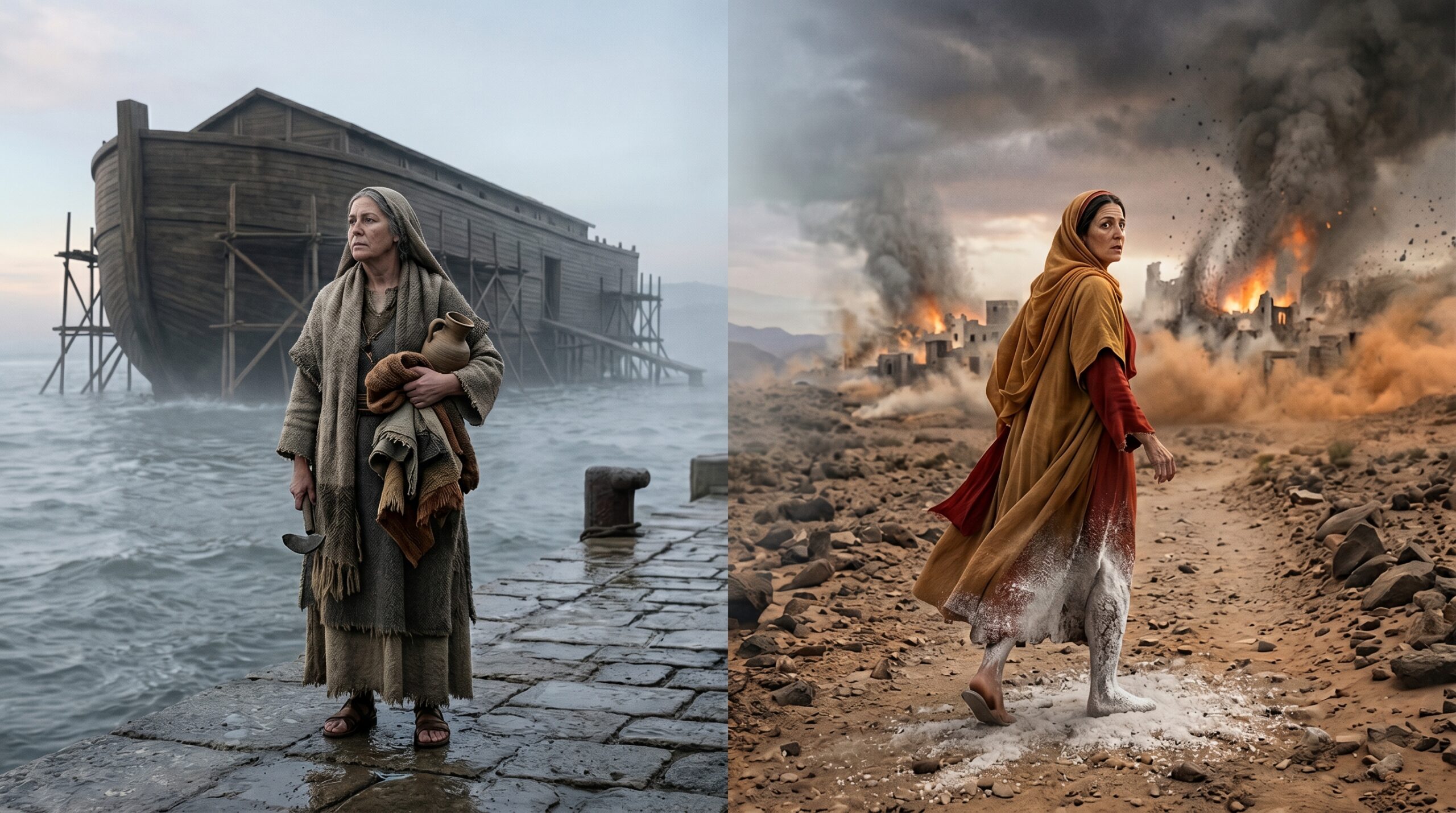
Lot's Wife looked back. We have been calling this a mistake. It was not a mistake. It was a confession.
Looking back was not an act of memory. It was an act of freezing. The moment the gaze returns to what is being left, the leaving stops. The body turns but the self does not. And what happens at the boundary between moving and not moving, between the new life and the old one, between the boat and the shore, is salt.
Salt is what remains when the water leaves. When the aliveness drains out of a thing and only the residue stays, compressed, mineral, still shaped like the original. You have seen people who became salt. Who remained permanently at the edge of a transformation they could not complete. Who kept the shape of someone in motion while being absolutely, terrifyingly still. Who referenced the flood for years, described the boat in detail, spoke fluently about the city being destroyed without ever having fully left it.
They became monuments. To the moment of hesitation. To the version of themselves that weighed too much to move. The salt does not know it is salt. That is the cruelest part of it. The monument believes it is standing at the edge, still deciding. It does not know the decision has already been made: by the weight it chose to carry, by the look it chose to take, by the story it refused to let reach its ending.
The Physics of Inertia
Here is what the staying actually looks like, from the inside, where it is almost completely invisible. You are engaged with something important. You can feel the pull of it, the reality of it, the way it is clearly true and clearly the direction. And there is a part of you: not a loud part, not a dramatic part, a very quiet, very heavy part, that simply does not go. That remains in a room you have already finished living in. That keeps sending you back to check on things you know have not changed, to revisit conclusions you have already reached, to maintain the narrative infrastructure of a self that has already, in every meaningful way, run its course.
You know what you should do. This is the specific agony of the archetype. Not the confusion of someone who cannot see the way forward, but the peculiar torment of someone who sees it with complete clarity and finds, when they try to move toward it, that their own weight is working against them. The body knows the shore. The self refuses to leave it.
You finish sentences you stopped believing. You follow patterns selected by a version of you that no longer exists, responding to conditions that have long since changed. You play the role you auditioned for years ago: the role that made sense at the time, in that context, for that version of the story. And the performance is so practiced that it no longer feels like performance. It feels like identity. The relationships arranged around the old story require its maintenance. The commitments made inside the old self require its continuation. The belief system that answered all the questions correctly at twenty three is still running, because replacing it would mean admitting it was incomplete, and admission has a cost the Palace will not pay.
Inertia is not laziness. Inertia is loyalty to a self that should have been outgrown. It is protection of an investment that stopped appreciating. It is the exhausting, invisible, constant work of maintaining a version of yourself that is no longer growing, which takes, paradoxically, more energy than transformation would. The anchor is heavy. Carrying the anchor and calling it identity is heavier still.
The Weight Check
This is not a plan. Plans belong to people who know where they're going. This is an assessment: a reckoning with what you are actually carrying, and what it is costing you to carry it.
Name the shore you won't leave. Not in general terms. The specific story. The specific identity investment. The particular version of yourself that would have to end for you to step onto the boat. Who are you protecting? What are you maintaining? What self has so much of your history deposited into it that abandoning it feels like losing the evidence that your past meant something? You don't have to leave it yet. You only have to see it clearly enough to call it what it is: a shore, a fixed point, a place where the water is rising and you are still standing, holding your old life with both hands, watching the boat.
Feel the weight without explaining it. This is harder than it sounds. The explanatory function of the ego is fast and fluent: the moment you touch something heavy, the narration begins. The context, the reasons, the circumstances, the ways in which the situation is more complicated than it appears. Let the narration go, for just a moment. Let the weight be weight. Notice what it takes to maintain a self that has stopped growing. Notice the energy required for the maintenance. Notice what you are not doing with that energy. The weight is the Warning You Already Heard, made physical. It is your own psyche, pressing down on you with the accumulated cost of remaining where you are.
Ask what is actually beneath the fear. The fear is never really about the Unmapped Territory. People tell themselves it is: the uncertainty, the risk, the absence of guarantees. But the Unmapped Territory is not what you're afraid of. You're afraid of the moment of admission. The instant in which you acknowledge that you have been in the wrong story long enough to have built a life inside it. The pain of understanding that you stayed in the room after you'd finished living in it, and that the staying was a choice, and that the choice had consequences. This is the real weight. Not the future. The past. The accumulated cost of the distance between who you knew yourself to be and who you were actually being.
Take one step toward the unmapped. Not the whole journey. Not the dramatic, total transformation that makes for a cleaner story. One step: toward the conversation you've been having with yourself for months, toward the version of yourself that exists only in the Unmapped Territory, waiting with no impatience, because it will only exist when you create it by moving. The boat is still at the harbor. That is not a metaphor for hope. It is a statement about time, and time moves in one direction.
Noah's Wife was not a cautionary tale about disobedience. She was a cautionary tale about the cost of the story you tell yourself about yourself: how much weight it can accumulate, how real that weight is, how completely it can hold you to a shore that is going underwater while you stand on it.
You already know what the boat is. You have known for some time. The knowing has not been the obstacle. The obstacle is what you are still holding. The residue of the self you've protected. The salt shape of who you were, standing at the edge of who you could be, looking back at the evidence that the first one existed.
Somewhere at the harbor, the horn sounds. Not for the first time. It has been sounding for a while now: low, far away, underneath the noise of everything you've been maintaining. You have learned to hear it as background. To explain it as something other than what it is.
It is the final call.
The question is not whether you are ready. You will not be ready. Readiness is a story the old self tells to justify the staying.
The question is whether you are willing to put down what you're carrying long enough to walk to the end of the dock.
The water is rising. The boat is there. And you are still holding something that will not float.
Next in the Series: Haman: The Architect Who Builds the Tower for Someone Else