 IMRA'AT AL-AZIZ · Section Eight
Section Eight
When the Seduction Returns
The house learns from the refusal
It does not repeat. It upgrades. Arriving next time in a different register, using the language of the previous refusal.
The Specific Shape of This Recurrence
Imra'at Al-Aziz returns quietly
When Abu Lahab returns, it announces itself with heat.
When the Samiri returns, it arrives with an upgraded substitute.
Imra'at Al-Aziz returns quietly.
Not with a new argument.
Not with an obvious reappearance of the commands.
With a tone.
A slight shift in how the decision is being held internally.
A subtle sense that the clarity,
which was present and refused to negotiate,
is now available for one more conversation.
Not because something happened.
Because enough time passed
for the house to reorganize itself
and approach again,
this time from a different angle,
using the language of the previous refusal.
How the House Learns
What makes this recurrence more difficult than the others
This is what makes the Imra'at Al-Aziz recurrence
more difficult than the others:
The house learns from the refusal.
After the refusal to sit down at the table,
the commands do not simply repeat.
They study what worked.
They note which form of reinterpretation was refused.
They arrive next time in a different register.
- If the refusal came from recognizing "not yet" as a command, the return comes as "now you have had more time to think."
- If the refusal came from recognizing rationalization, the return comes as "genuine complexity you previously overlooked."
- If the refusal came from naming the house as the house, the return comes as "a more balanced and mature perspective."
The seduction does not disappear.
It upgrades.
The Three Forms of Return
Each one more subtle than the last
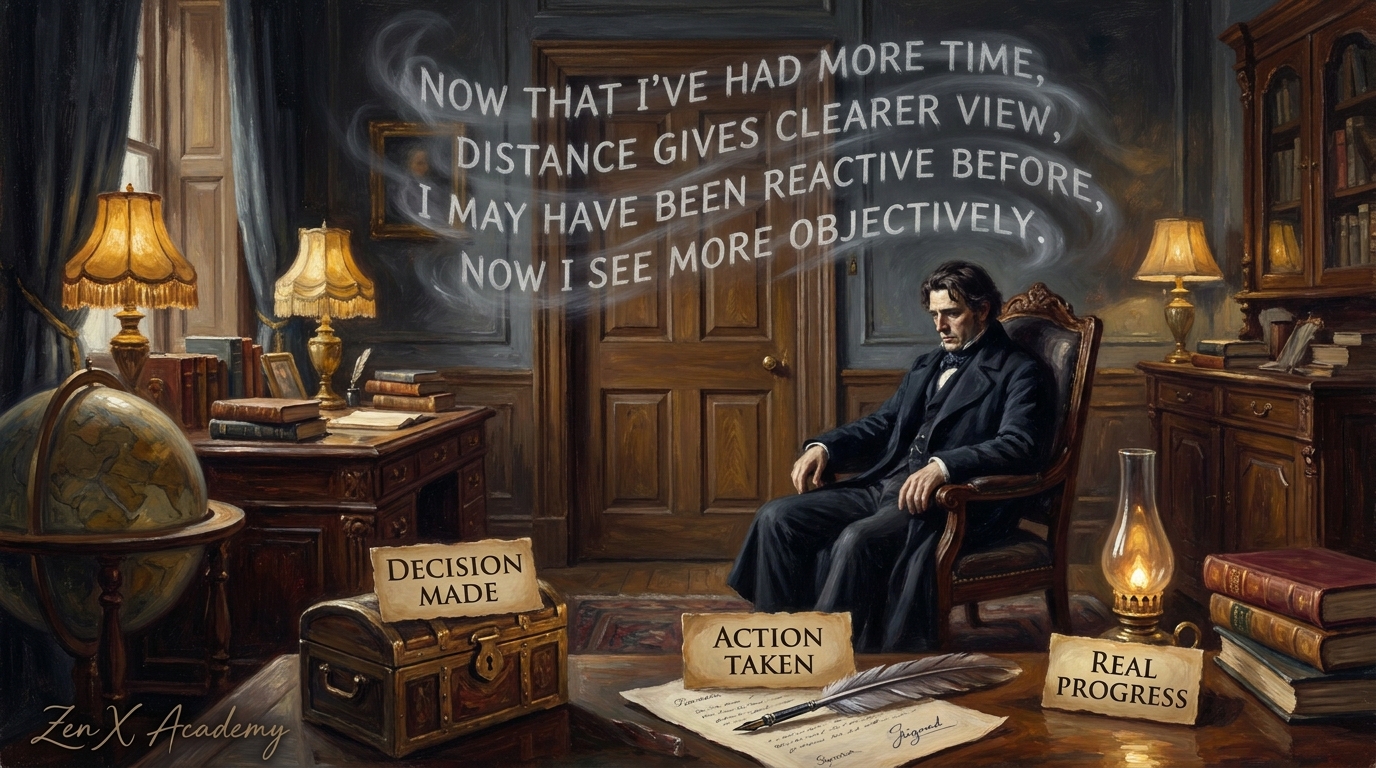
Delayed Wisdom
Arriving after genuine progress
This arrives after a period of genuine movement.
Something was decided.
Something was acted upon.
Real progress occurred.
And then, specifically after the progress,
the inner conversation reconvenes.
- "Now that I've had more time to reflect on this..."
- "Distance has given me a clearer view of what was actually happening."
- "I may have been reactive before. Now I can see it more objectively."
The language is the language of maturity.
Of perspective gained through experience.
Of someone who is finally seeing clearly.
The Specific Signature
The Re-Entry
The most insidious form
This form is the most insidious
because it does not feel like a return.
It feels like continued progress.
After the refusal to enter the house,
the house begins to re-establish contact
incrementally.
Not with an offer.
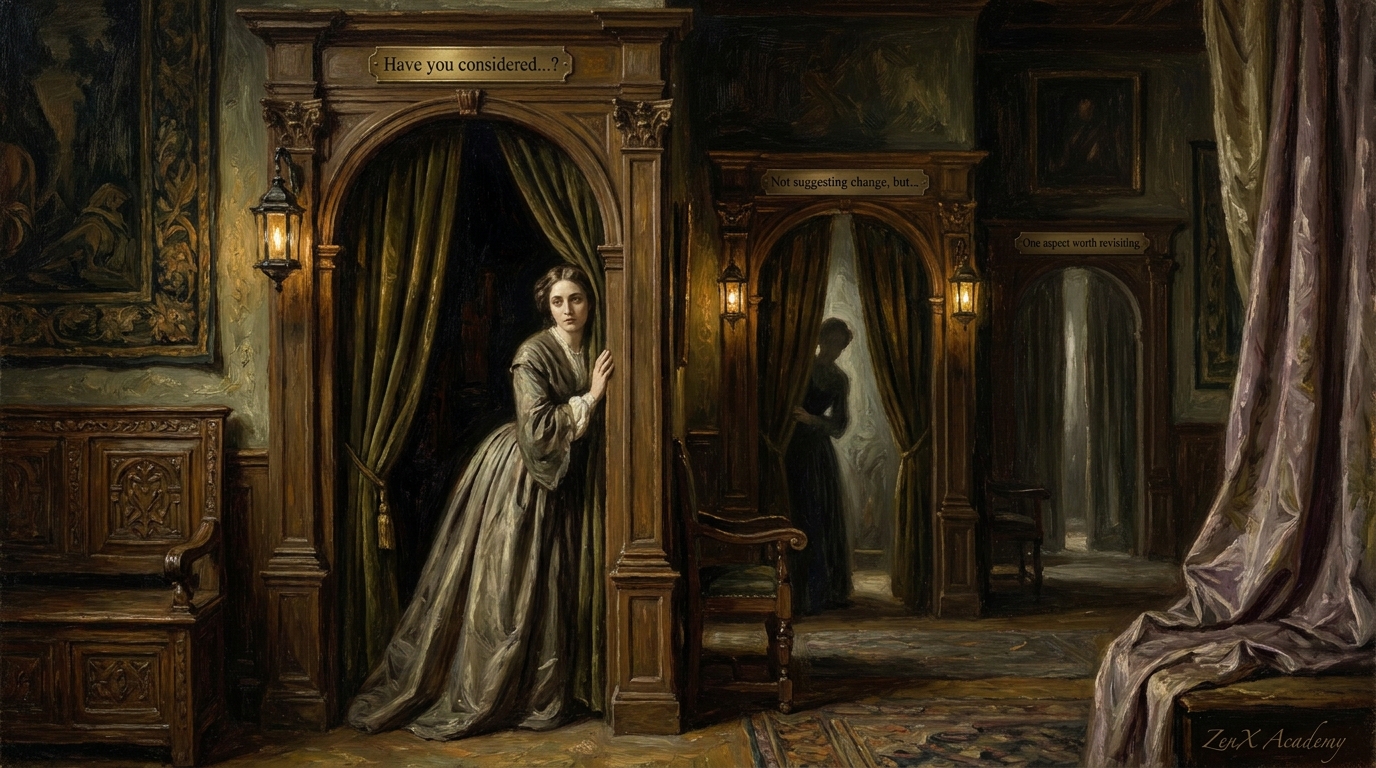
With a question.
- "Have you considered...?"
- "I'm not suggesting you change course, but..."
- "This one aspect might be worth revisiting."
One door. Then another. Then another.
Until, at some point, the conversation is happening
from inside the house again,
and the entry was so gradual
that the precise moment of crossing the threshold
cannot be located.
This is the re-entry.
The Signal
Borrowed Authority
The most sophisticated return
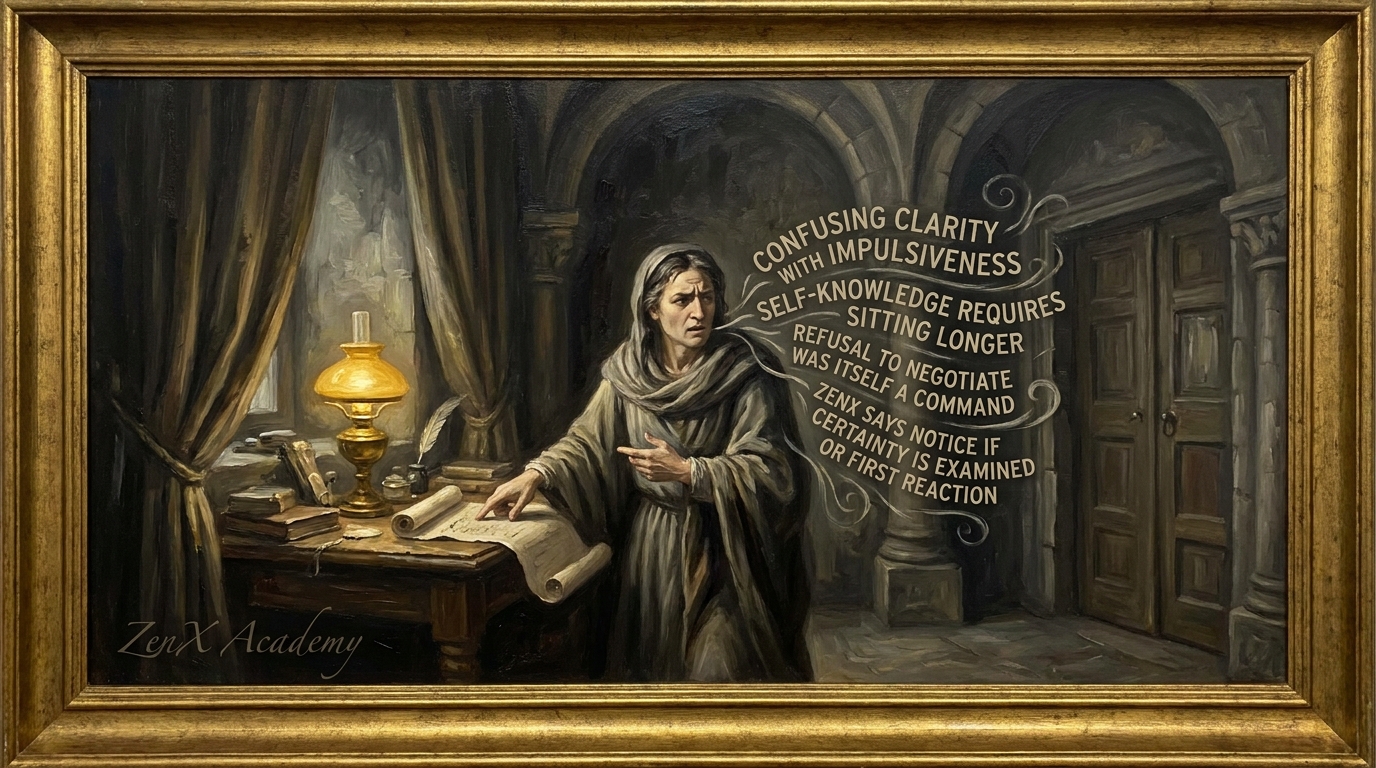
The house returns using the language of the work itself.
- "I think I've been confusing clarity with impulsiveness. Real self-knowledge requires sitting with this longer."
- "I wonder if my refusal to negotiate was itself a command running, a rigidity I haven't examined."
- "The framework would say I should notice if this certainty is the examined position or the first reaction."
The framework, the vocabulary of this room,
is being used to reopen the negotiation
it was designed to interrupt.
This is the most sophisticated return.
And the one that requires the greatest precision to recognize.
Because the questions it raises are legitimate.
Certainty should be examined.
Rigidity is worth noticing.
The Signature
"Now the Truth Has Become Clear"
When the house sees itself from outside
In the ancient account,
there comes a moment
when Imra'at Al-Aziz stops negotiating.
"Now the truth has become clear."
She stops reinterpreting.
She stops rationalizing.
She names what actually happened.
"I seduced him. He was truthful. I was wrong."
This is not the end of the story.
It is a crucial movement within it.
The house, when it has been seen clearly enough,
when the pattern has been named with enough precision,
will eventually produce this moment.
Not immediately.
Not after one refusal.
But after enough cycles of
clarity, seduction, refusal, return, re-recognition,
something shifts.
The internal voice that had been reinterpreting
stops reinterpreting.
It acknowledges, with the specific weight of acknowledgment:
"I have been negotiating with this clarity.
The clarity was real.
The negotiation was the house."
This is not the elimination of Imra'at Al-Aziz. It is the first moment the house is seen from outside itself. And in that seeing, the decision-making faculty moves. Not freely. Not without cost. Not without the shirt tearing. But without the negotiation having the final word.
What Recurrence Reveals
The most precise diagnostic available
Every return reveals something
the original examination could not see:
- The specific conditions under which the house can still close its doors.
- The particular form of authority the commands still carry when they arrive upgraded.
- The domain where the re-entry happens most gradually, where the house is rebuilt one room at a time before you notice you are inside it again.
None of this is failure.
Each return is the house showing you its current architecture,
what it has learned since the last refusal,
and where it has found new entrances.
That information is the most precise diagnostic available.
Exercise Eight: The Return Record
Mapping what the house has learned
When the seduction returns after genuine work,
after a period of clarity and movement,
write four things:
1. The form. Which of the three forms appeared? Delayed wisdom, re-entry, or borrowed authority?
2. The language. What specific sentences arrived? Write them. Literally. The words the return used this time.
3. The upgrade. How is this version more sophisticated than the previous form you recognized and refused? What language did it learn from the refusal?
4. The acknowledgment. Has there been a moment in the current cycle where the negotiation acknowledged itself as negotiation? Even partially. Even briefly. If yes, what did that acknowledgment look like?
The record across multiple returns
will show you the architecture of your specific house,
not as a fixed structure
but as an adaptive system
that learns from each refusal
and reorganizes around the next threshold.
That knowledge is the most precise form of preparation
for what Section Nine describes:
the integration that does not eliminate the house
but changes your position relative to it.