 IMRA'AT AL-AZIZ · Section Seven
Section Seven
The Capacity That Refuses the House
Not willpower. Not moral victory. The refusal to enter the architecture of the offer itself.
What Yusuf actually is in this framework, and why it has nothing to do with being beyond the pull.
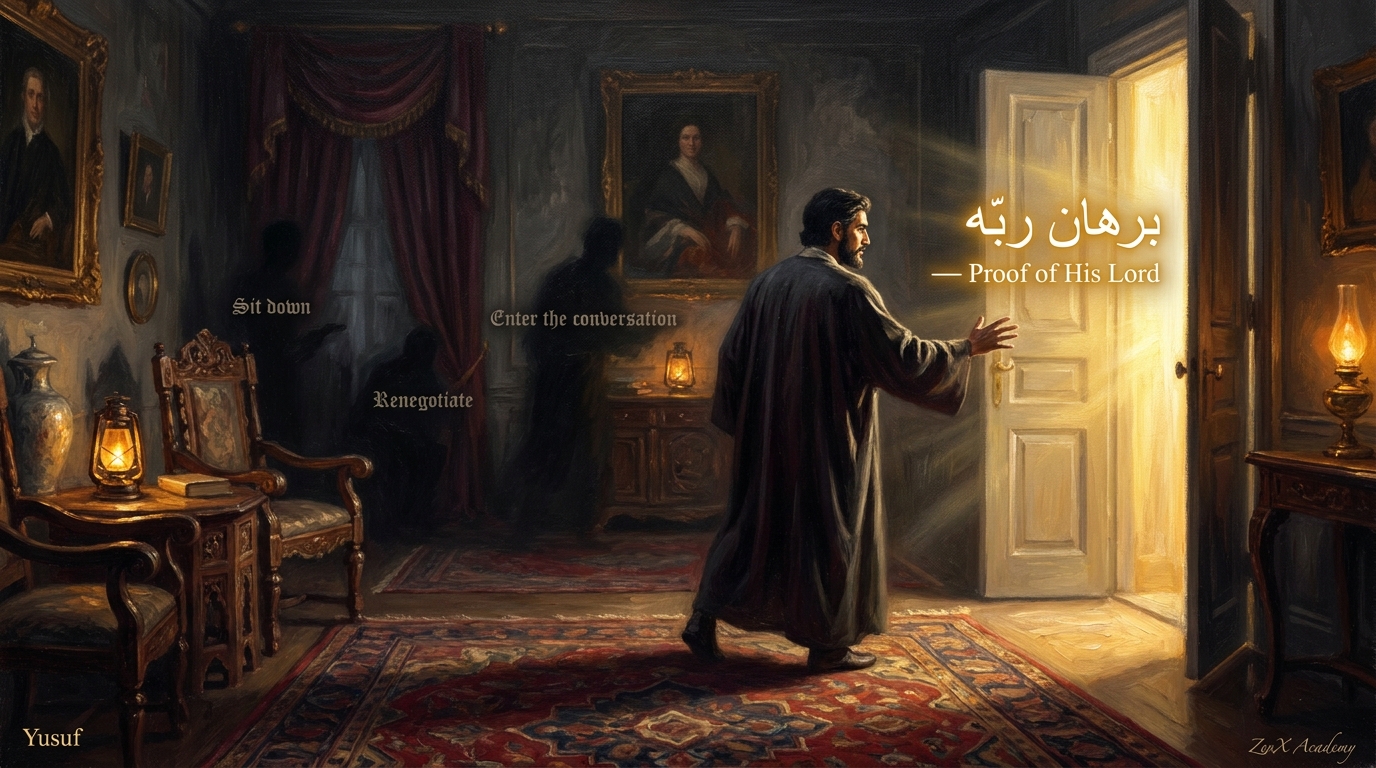
What Yusuf Actually Is
A clarification before this section explains anything
Yusuf is not the morally pure person.
Not the saint.
Not the one who never felt the pull.
The account does not say the pull was absent.
It says something far more specific:
He saw the proof of his Lord.
Not that he was beyond the negotiation.
That something in him had a reference point
outside the house,
outside the closed system,
outside the internal arrangement,
outside the voice that had been speaking longest,
that made him recognizable to himself
before the negotiation had a chance to complete.
And from that recognition:
that refusal.
What That Phrase Actually Means Here
Not a declaration of victory over temptation
Not: "God protect me from wanting this."
Not: "I am choosing virtue over desire."
Not a declaration of victory over temptation.
Something more specific and more operational:
"I am not entering this conversation."
The refusal is not of the thing being offered.
The refusal is of the architecture of the offer itself.
The doors are being closed.
The house is arranging itself for negotiation.
The first sentences of reinterpretation are forming.
And something in Yusuf does not sit down.
Not because he has defeated the desire.
Because he has a reference point
that the negotiation cannot reach.
That refusal, operationally, means: "My position is not available for renegotiation through this process."
The Reference Point
What the seduction cannot enter
This is what the seduction cannot enter.
The account describes it as the proof of his Lord.
In psychological terms:
a contact with something real
that exists prior to the house's arrangements,
outside the house's language,
immune to the house's reframing.
Not certainty.
Not immunity from difficulty.
Not the absence of the pull.
A contact with the clarity
that was present before the negotiation began,
that remains available as a reference
even after the house has closed its doors.
This is what makes the Yusuf capacity different
from willpower, discipline, or moral fortitude.
- Willpower works against the seduction.
- The Yusuf capacity refuses to enter the structure within which the seduction operates.
One is a battle inside the house.
The other is the recognition
that the battle itself is inside the house,
and that stepping outside it
is a different kind of movement entirely.
The Torn Shirt
Evidence of contact between two systems
Yusuf's shirt is torn from behind.
Not from the front,
not torn by something he was running toward.
From behind,
torn by the system that was pulling him back
into the arrangement he was leaving.
The shirt is the interface.
The thing that can be read.
That presents something to the world.
That can be held up as evidence.
And in this moment,
the moment of leaving the house,
the shirt tears.
Not because the leaving was wrong.
Because the house resisted the leaving.
The torn shirt is the evidence of contact
between two different systems:
the direction Yusuf was moving
and the arrangement that was trying to maintain him.
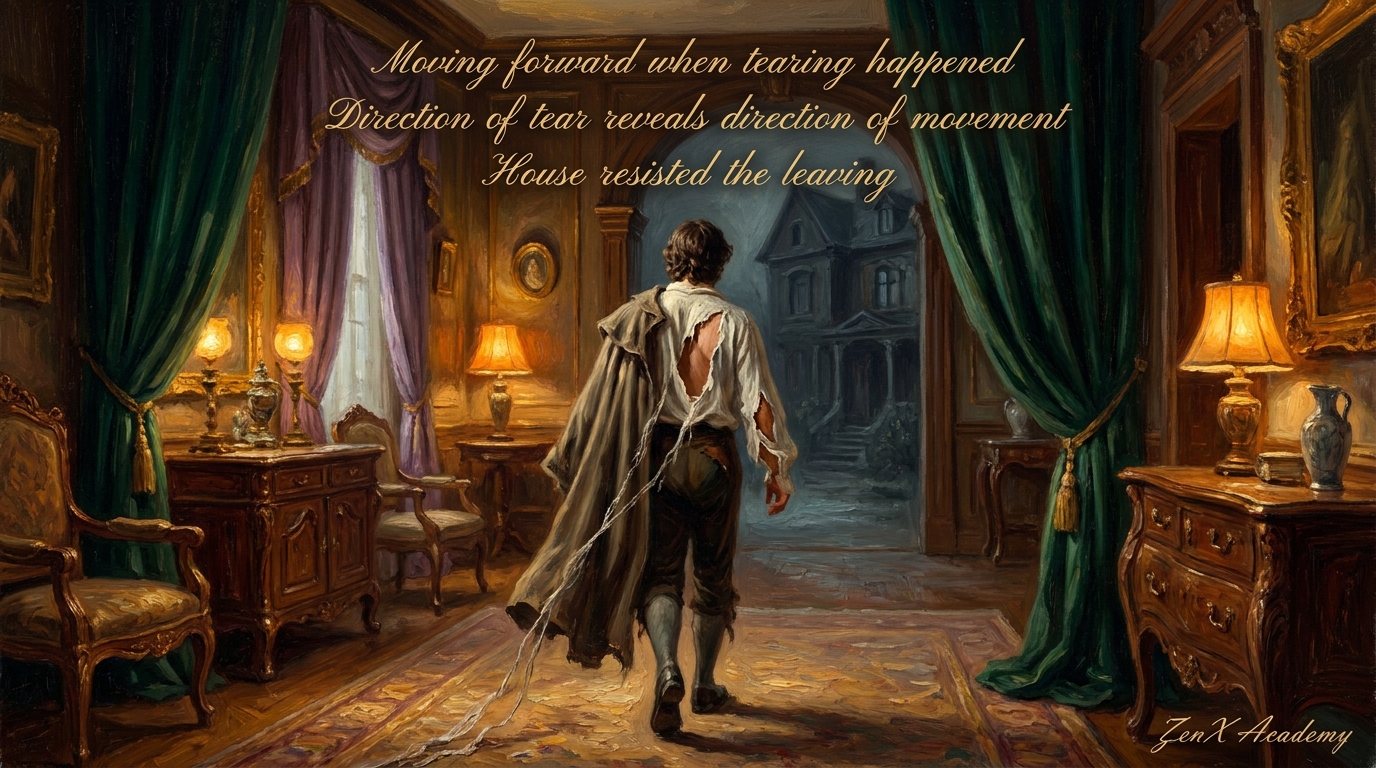
What the Shirt Reveals
The direction of the tear reveals the direction of the movement
The shirt reveals the direction of movement.
It was torn from behind.
Which means Yusuf was moving forward
when the tearing happened.
This is the specific evidence
the one who examines the situation uses to read what occurred:
"If his shirt is torn from behind,
she is lying and he is truthful."
In psychological terms:
the direction of the tear
reveals the direction of the movement.
When you are moving toward the clarity,
when you are refusing the house and its negotiation,
there will be tearing.
The arrangement will resist.
The commands will intensify.
The seduction will produce its most convincing language
at exactly the moment of leaving.
This is not evidence that the leaving is wrong.
It is evidence that something real was being left.
The house does not produce its most sophisticated arguments when the decision is unimportant. It produces them when the decision matters, when genuine movement is actually happening.
The quality of the resistance is sometimes the most accurate information about the quality of the direction.
What the Refusal Requires
Less than most people assume
It does not require the absence of the pull.
Yusuf was inside the house.
The doors were closed.
The seduction was real.
It does not require certainty about the decision.
The proof of his Lord was not certainty about outcomes.
It was contact with something that existed
prior to the house's arrangement.
It does not require silence from the inner voice.
The commands will still produce their language.
The sentences will still arrive.
The reinterpretations will still form.
What the refusal requires is only:
The refusal to treat those sentences
as the final adjudicator of the decision.
Not: "The voice is wrong."
But: "The voice is the house speaking. And the house's preference is not the same as my reference point."
What Changes When the Capacity Develops
Not the elimination of the seduction
Not the elimination of the seduction.
The commands will still activate.
The house will still close its doors.
The language will still arrive.
What changes:
The reference point becomes more available.
The contact with the clarity that existed before the negotiation
becomes easier to locate,
not because the negotiation stops,
but because the practice of noticing it
builds the capacity to step slightly outside it.
The gap between the first sentence of reinterpretation
and the moment when the clarity is lost
begins to widen.
Not dramatically.
Not all at once.
Not in every domain simultaneously.
But in the specific domain
where the work has been directed,
something changes in how the house's closing
is experienced.
Less like reality.
More like the house doing what houses do.
Exercise Seven: The Clarity Test
Three questions, written honestly
Return to the decision or direction
you have been working with throughout this room.
Three questions. Write honestly.
Question One: The Reference Point
Before the commands and before the house, what was the clarity?
Not what you think you should want. Not what sounds growth-oriented. What was actually clear, in a specific moment, before the inner conversation began?
Question Two: The Shirt
What has been torn in the direction of that clarity?
Not what has been lost to the seduction. What has already moved toward the direction, what has already been acted upon, even partially, that the arrangement has resisted or questioned?
Question Three: The Refusal
What would it mean, in your specific situation, to not sit down at this particular table?
Not to refuse thinking about it. Not to force a decision. To refuse the architecture of the specific negotiation, the specific form of reinterpretation that the commands in Section Six have been producing, as the governing process for this decision.
What would that look like, practically, in the next week?
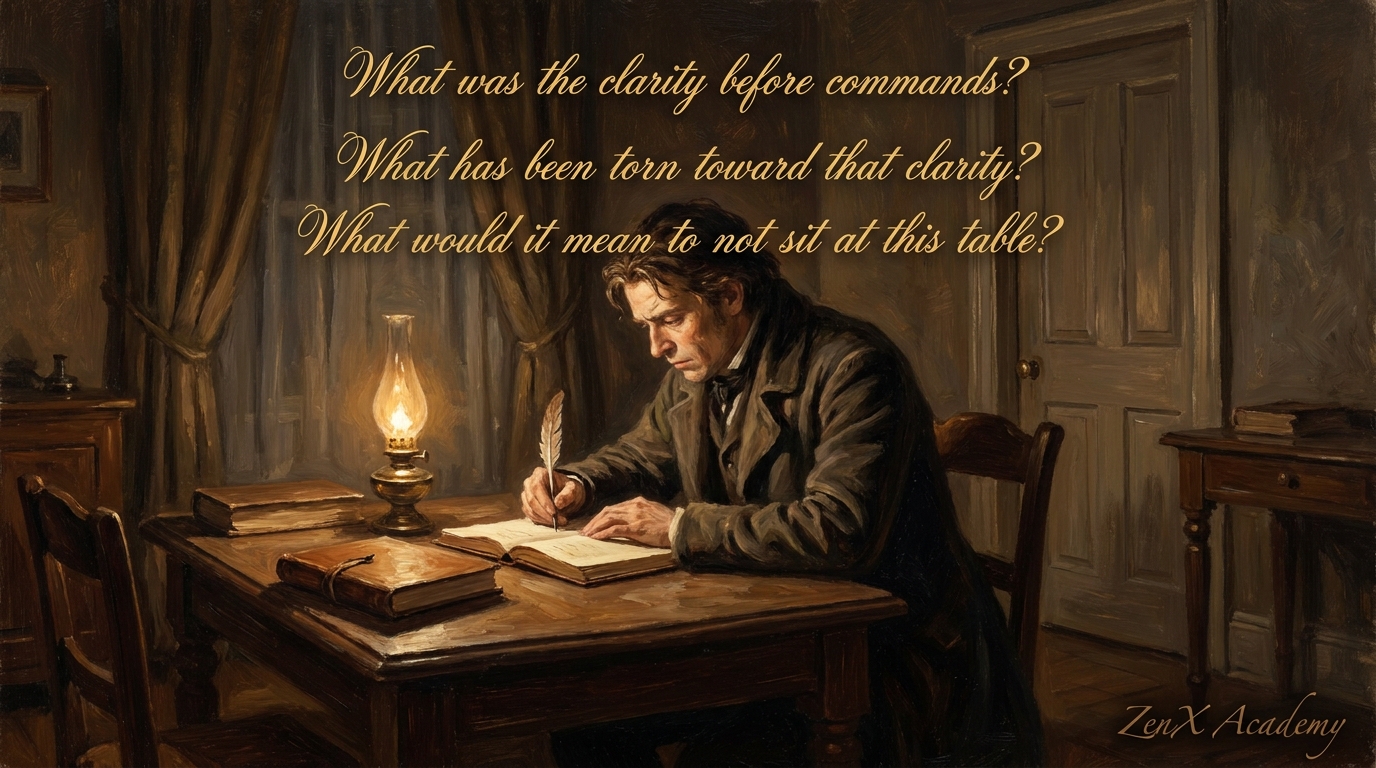
One Sentence
The conversation you are refusing to continue
"The conversation I am refusing to continue in order to stay in contact with what was clear is: ______"
Section Eight addresses what happens when the seduction returns, because it will, and what its return reveals.