 IMRA'AT AL-AZIZ · Section Nine
Section Nine
Living With the House
Not the elimination of the house. The change in what happens inside the re-entry.
If the house will always be there, if the commands will always regenerate, what does freedom actually look like?
The Question This Section Answers
Not the freedom of having left the house once
If the house will always be there,
if the commands will always regenerate,
the seduction always upgrade,
the re-entry always find new angles,
what does freedom actually look like?
Not the freedom of having left the house once.
Not the freedom of a single refusal.
But the kind of freedom available
to someone who knows they will encounter the house again,
who has returned from it multiple times,
and who has stopped treating that fact as evidence of failure.
What Happens When You Stop Fighting the House
The cost of treating the house as an enemy
There is a specific cost to treating the house as an enemy.
Every encounter becomes a battle.
Every inner sentence requires diagnosis.
Every hesitation must be interrogated.
Every voice of complexity must be tested for seduction.
This produces a particular kind of exhaustion,
not the exhaustion of someone doing real work,
but the exhaustion of someone who has made vigilance
the primary activity of their inner life.
And in that exhaustion,
the house wins differently.
Not through seduction.
Through the depletion that comes from perpetual warfare
with your own internal system.
The work is not the elimination of the house. The house was built from something. The commands formed in response to something real. The protections guard things that were genuinely worth protecting at some point.
The house is not the enemy. It is the arrangement that formed in the absence of a clearer direction.
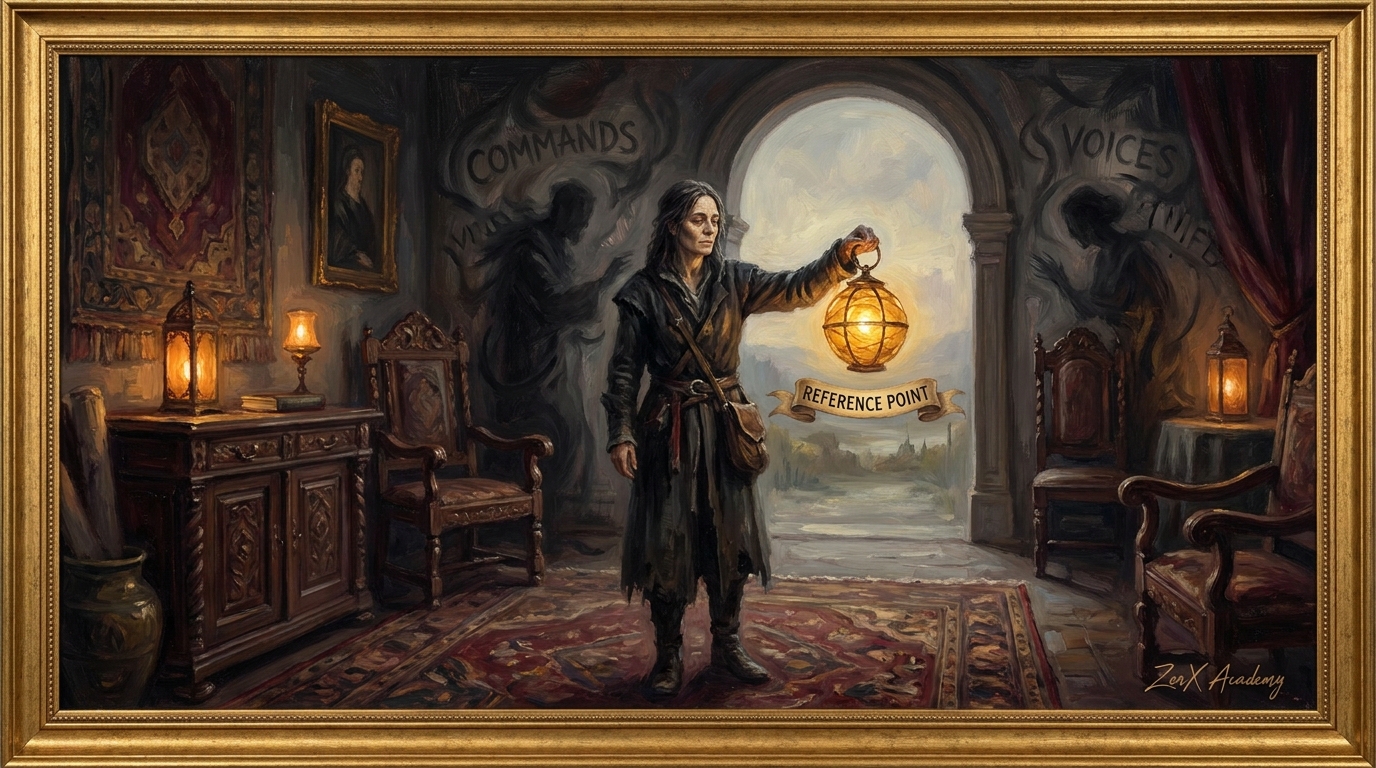
And the work is not to destroy it. It is to have somewhere else to go, a reference point outside it, that makes living in it a different kind of inhabiting.
What Coexistence Actually Looks Like
Something has changed in the quality of the encounter
The commands still produce their language.
The house still closes its doors.
The seduction still upgrades.
But something has changed in the quality of the encounter.
It is recognized earlier.
Not immediately. Not perfectly.
But earlier in the sequence than before.
The first sentence of reinterpretation is heard
before it has produced the second.
It has less authority.
The commands still arrive.
They still use your vocabulary.
They still reference your real history.
But the authority they carry,
the unquestioned weight of the voice
that has been speaking the longest inside the house,
has become slightly more questionable.
Not distrusted entirely. Not dismissed.
But held with the awareness that it is
one voice among several,
not the adjudicating voice that settles the question.
It no longer requires a verdict.
This is the most important shift,
and the one that takes the longest to develop.
Early in this work,
every encounter with the house required a decision:
- "Is this the seduction or is this genuine?"
- "Is this the command or is this real uncertainty?"
- "Should I trust this or name it?"
The continuous evaluation is exhausting.
And it keeps the attention focused on the house
rather than on the direction.
With practice, something changes.
The house is present.
The commands may be running.
The reinterpretation may be forming.
And the decision does not need to be made
about whether any of it is "the seduction."
The question shifts:
"What is the clarity that was present before this? Where is it now? Am I moving toward it or has the conversation moved me from it?"
That is the only question that matters. Not the diagnosis of the house. The contact with the reference point.
What Integration Is Not
Three things it does not require
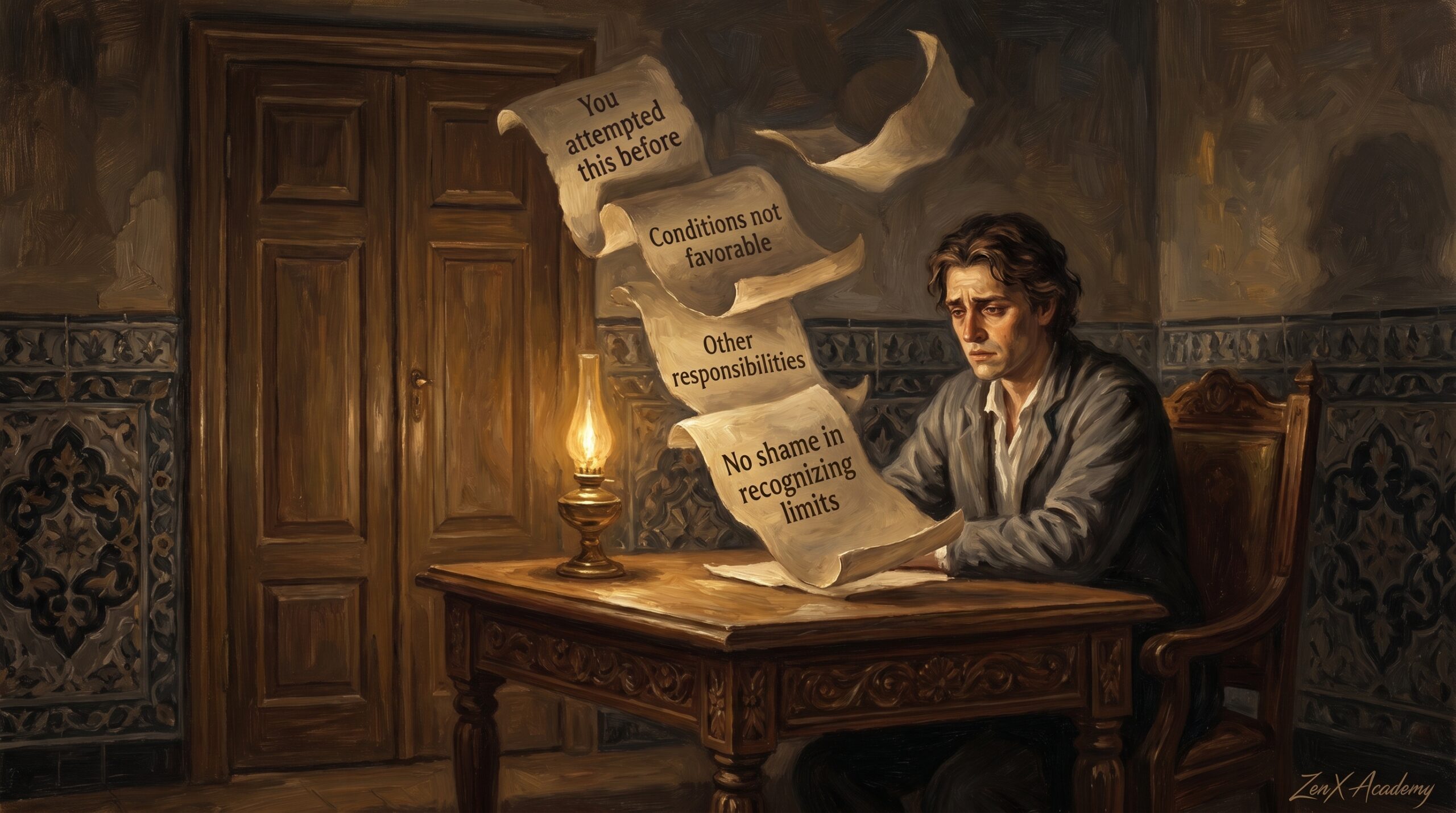
Integration is not the permanent maintenance of clarity.
Clarity will be lost and found and lost again.
Integration is not the elimination of the commands.
The commands will continue.
Integration is not the ability to never re-enter the house.
Re-entry will happen.
Integration is the change in what happens inside the re-entry.
The house closes its doors.
You are inside.
The negotiation is running.
And something, not immediately, not perfectly,
recognizes that the doors are closed.
That the complexity that now feels central
was not central before the conversation began.
That the voice that sounds most like mature wisdom
is the one worth examining most carefully.
And from that recognition,
however late it arrives in the sequence,
however imperfect the timing,
the movement begins again.
Not freely.
Not without cost.
Not without the shirt tearing.
But it begins.
Three Signs That Integration Is Occurring
How the work shows up over time
The House Feels Like a House
No longer mistaken for reality itself
Early in this work,
the house felt like reality.
Its arrangement was the arrangement of things.
Its voice was the voice of accurate perception.
Its closedness was not a closing.
It was simply where you were.
Integration is underway when the house begins to feel like a house,
a specific structure, with specific features,
that was built by someone, you, over time,
for specific reasons,
rather than the neutral ground of reality itself.
This shift is small.
It is not dramatic.
But it changes the quality of every encounter with the house
from that point forward.
The Commands Are Legible
More of their structure visible
The commands still arrive.
But they arrive with more of their structure visible.
Not always. Not immediately.
But with some frequency,
you hear the sentence:
- "I just need more time."
- "I'm being realistic about myself."
- "I need to protect what I've built."
And something registers:
"That is the house running its language.
That is the specific form of the command
that has appeared at this threshold before."
Not always in time to interrupt.
But in time to name.
And naming, as this room has established,
is the beginning of being outside the house.
Holding the Clarity and the House Simultaneously
The integration itself
Early in this work,
clarity and the house's negotiation were in competition.
When the house was present,
the clarity felt unavailable.
When the clarity was present,
the house felt distant.
Integration is underway
when both can be held at the same time:
"The house is present. The seduction is running. The commands are producing their language. And the clarity is still here. These are not mutually exclusive. The house doing what houses do does not mean the clarity was wrong."
This simultaneous holding,
this capacity to remain in contact with what was clear
while the negotiation is actively running,
is the integration.
Not the silence of the negotiation.
The unbroken contact with the reference point despite it.
The reference point is not infallibility.
Clarity can be incomplete.
Decisions can require revision.
Movement can reveal information
that was not available before the movement began.
The work is not loyalty to every original certainty.
The work is maintaining contact with the place
from which the certainty emerged,
so that revision comes from seeing more,
not from the house reopening a negotiation
it has already conducted many times before.
That distinction,
between revision as seeing
and revision as the house returning,
is what the practice is building.
The Minimal Daily Practice
One question. When it is relevant.
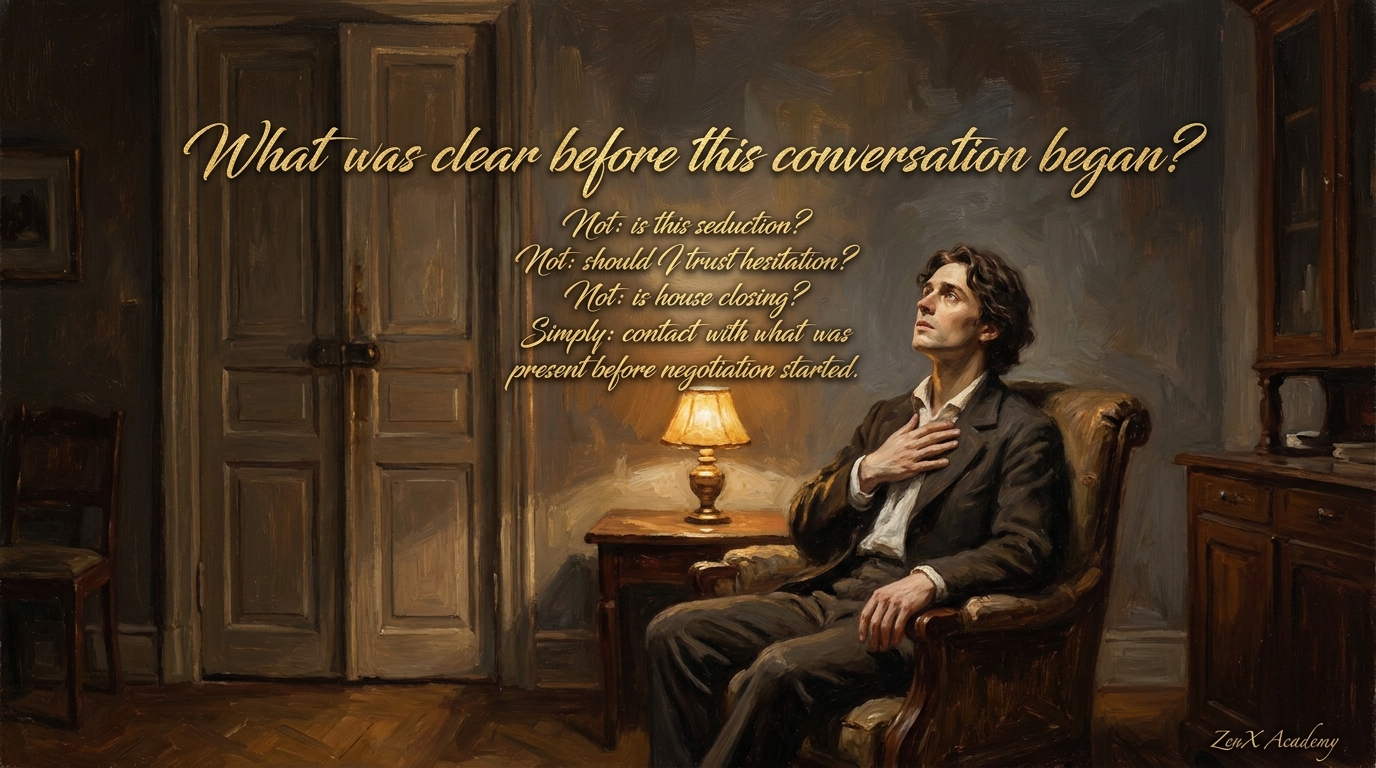
"What was clear before this conversation began?"
Not: is this the seduction?
Not: should I trust this hesitation?
Not: is the house closing?
Simply:
"What was clear before this conversation began?"
That question re-establishes the reference point
without requiring the diagnosis.
It does not dismiss the conversation.
It does not eliminate the house.
It asks only for contact
with what was present
before the negotiation started.
That contact, maintained, recovered, and maintained again,
is the practice.
Section Ten closes the room, not with a resolution, but with what the room itself has been building toward: the quality of movement available to someone who knows the house intimately and has stopped mistaking it for home.