 HAMAN · Section Five
Section Five
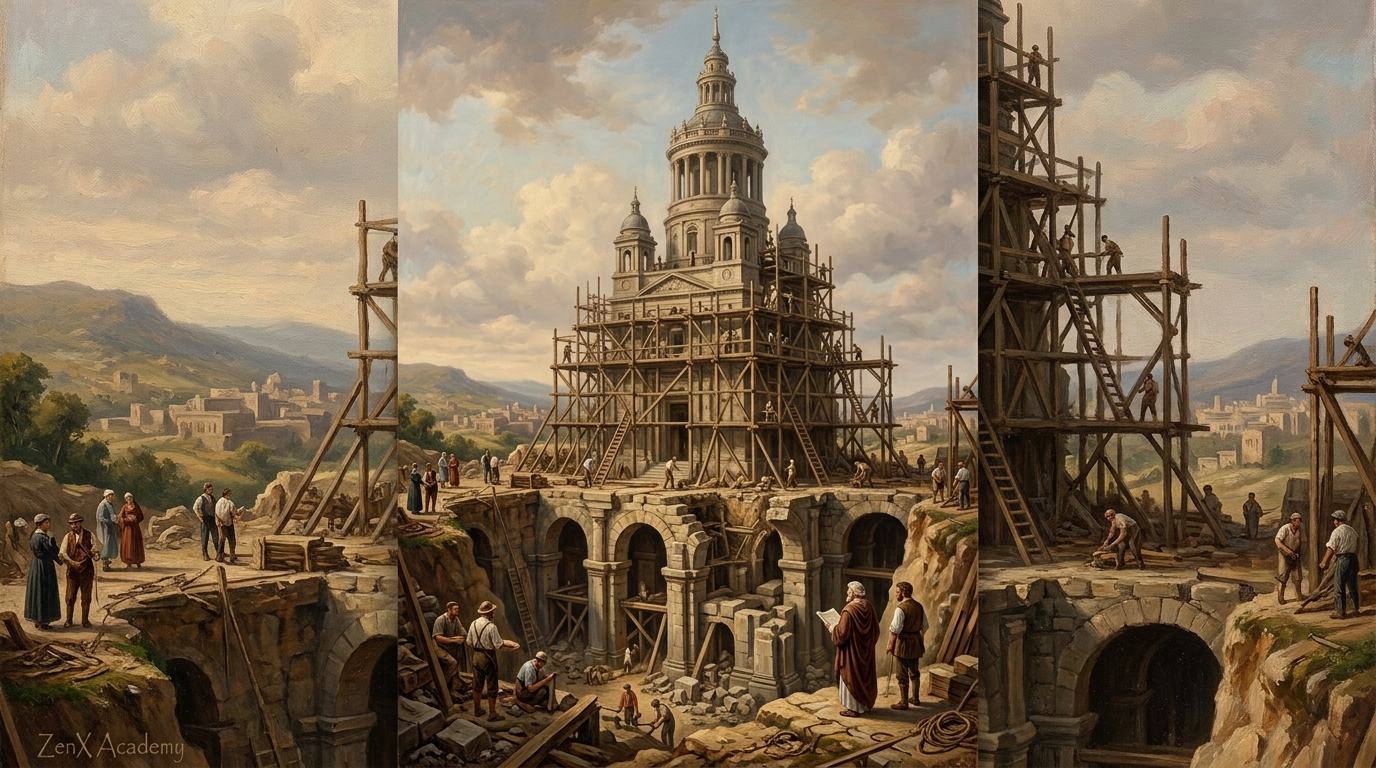
What the Tower Protects
The announced purpose versus the real function
There is a moment, sometimes, when someone comes close enough to the base of the tower — through conversation, through silence, through an unexpected question — and something shifts. Not collapse. Not even movement. Just a brief exposure of what the tower is standing over.

The Announced Purpose vs. The Real Function
Every tower announces a purpose — and the announcement is not false
Every tower announces a purpose.
And what is almost always there, underneath,
is not what the tower claimed to be protecting.
These are not false announcements.
The tower does, in some sense, perform these functions.
But they are not the primary function.
The primary function is simpler,
and deeper,
and much harder to look at directly.
- The Identity Tower says: I protect who you are.
- The Belonging Tower says: I protect where you belong.
- The Suffering Tower says: I protect what happened to you.
- The Sacred Authority Tower says: I protect what is true.
- The Achievement Tower says: I protect what you've built.
What Is Actually Underneath
One level below the announcement
- Beneath the Identity Tower: the possibility that the self you've organized around might not be fixed — and that without that fixed point, you don't know who is doing the living.
- Beneath the Belonging Tower: the possibility that the group could survive your questioning it — which means the belonging was never as total as it felt, which means you were always somewhat alone inside it.
- Beneath the Suffering Tower: not the suffering itself, but a specific question the suffering was answering: If this wasn't done to me, or wasn't as severe as I understood it — what does that make me? What was I responding to all this time?
- Beneath the Sacred Authority Tower: the possibility that the authority is legitimate, the teaching is real — and still, independently, your examination is also legitimate. The tower protects against the coexistence of these two things.
- Beneath the Achievement Tower: the specific calculation that has been running since the achievement began: If I stop, if I question, if the ground shifts — does any of what I built still count?
The Common Structure
Notice what these have in common
Notice what these have in common.
None of them are protecting against an external threat.
They are all protecting against a question.
Specifically: a question about what remains
when the organizing principle is interrupted.
The tower is not protecting content.
It is protecting against a specific exposure — the moment a framework becomes visible as a framework.
Not ignorance. Not stupidity. Not failure.
The specific moment when the frame through which you have been understanding everything
stops being invisible —
stops being simply "how things are" —
and becomes visible as a frame.
As one way of holding things among other possible ways.
This is what Haman builds toward.
Not pride, not power, not even certainty.
A structure that prevents the frame from ever being seen as a frame.

Why This Matters for the Examination
The architecture is not the thing
When you're inside a tower and a question arrives,
the response feels like: this question threatens something real.
And in one sense, it does.
But what it threatens is rarely what the tower says it threatens.
The question rarely threatens your actual identity,
your actual relationships, your actual past,
your actual values, your actual work.
What it threatens is the specific architecture
through which those things have been held —
the moment that architecture would stop being background
and start being visible as architecture.
And here is what the tower cannot tell you:
The architecture is not the thing.
You can examine the architecture without losing the thing.
In fact — and this is the claim that Haman finds most dangerous —
Examined things tend to be held more stably than unexamined ones.
Because what you've actually looked at, you actually possess.
What you've only protected, you've only managed.
The Specific Fear Haman Converts
Before clay, before kindling
There is a raw material Haman works with,
before clay, before kindling.
It is this:
The fear that examination leads to loss.
This fear is not irrational.
Examination sometimes does lead to loss.
Some things do not survive being looked at carefully —
not because they were false,
but because you outgrow the form they were held in.
Haman does not invent this fear.
He converts it.
He takes the real observation —
examination sometimes changes what you hold —
and extends it into an absolute:
examination is inherently dangerous to what you value.
And then he builds infrastructure around that converted fear,
so that avoiding examination feels like loyalty.
To your people. To your past. To your principles. To your pain.
To yourself.
The Question This Section Leaves
You do not need to answer this now
You do not need to answer this now.
But it is worth holding:
What is the specific frame in your life that has never been allowed to become visible as a frame?
Not: what is the tower protecting?
But: what would become visible —
about the frame itself, not about what it holds —
if the tower were to come down for even a moment?
Because Haman doesn't operate on the level of content.
He operates on the level of visibility.
The tower is built not against what will happen —
but against the single moment when the frame
stops being the world
and starts being a frame within the world.

The tower announces its purpose loudly. What it actually protects is quieter — and much closer to the center: the single moment when a frame stops being invisible and becomes visible as a frame.
Exercise: The Thing Beneath the Thing
Four parts — each one level deeper
Part One — Identification
Think of one area in your life where you've noticed consistent redirection, or language shift, or asymmetric standards — any of the indicators from Section Three.
Don't try to diagnose it yet. Just hold it in mind.
Part Two — The Announced Purpose
Write down, in one sentence, what this area is protecting. Use the tower's own language.
"This protects my..."
Part Three — One Level Down
Now ask: if the frame around this area became visible as a frame — if you could see it now the way you might see, in hindsight, a frame you've already outgrown — what would that moment of seeing actually look like?
Not: what would I lose?
But: what specifically would become visible that is currently invisible?
Part Four — The Distinction
Write two sentences:
1. The thing itself (the identity, the relationship, the value, the history, the work)
2. The architecture that has been holding it
They are not the same thing.
Noticing they are not the same thing is not a threat to the first.
It is the beginning of actually having it.
Section Six examines what happens when the tower's protection is no longer available — and what the examination actually costs, as opposed to what the tower says it costs.