 Room One · AZAR
AZAR
Who Is Running You?
Understanding the inherited programming that shapes your reactions, long before you had a say in any of it.
Introduction
Most of what you call your personality was installed in you before you were old enough to question it. The beliefs that feel most natural, the reactions that feel most like you, these were not chosen. They were absorbed. From a room, a voice, a silence that repeated itself in particular ways.
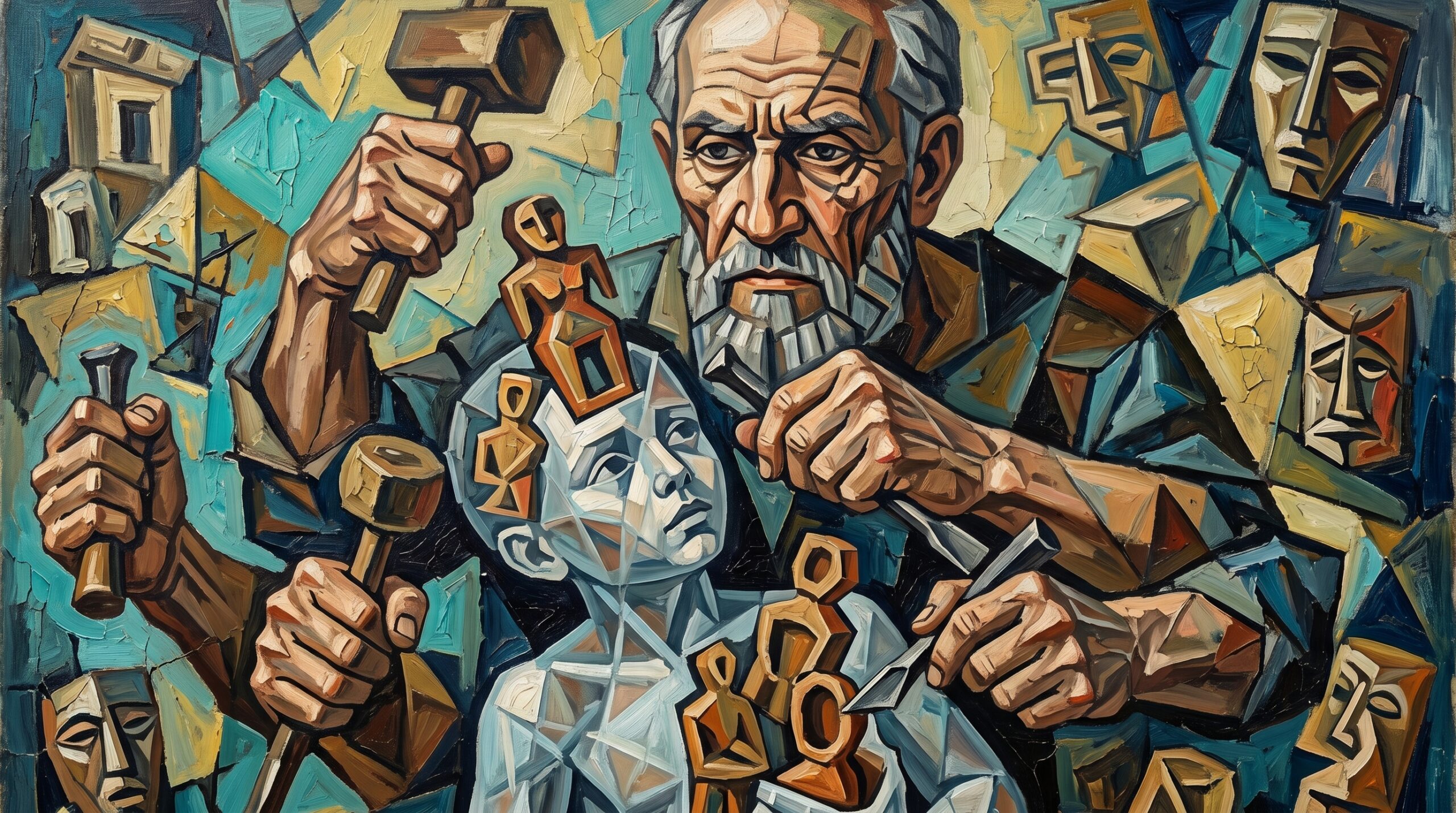
We named this room Azar because in the ancient texts, Azar was Ibrahim's father. He carved idols for a living. He shaped what others would then worship. He did not force anyone to believe. He simply produced the objects that belief would attach itself to, long before his son was old enough to ask: why do we bow?
That is the nature of inherited programming. It does not arrive as a command. It arrives as the furniture of the house. You grow up inside it. It becomes invisible. And then, one day, you look up and notice you have been living around it for years without ever deciding whether to keep it.
An idol is not always made of stone. Sometimes it is a belief. A way of seeing yourself. A rule about what you deserve or what you owe. The material does not matter. What matters is this: did you choose it, or were you shaped around it?
The question at the heart of AZARThis is not a room about blame. Azar is not a villain. He is a pattern, old, inherited, largely unconscious. The work here is not to condemn what you came from. It is simply to see it clearly, perhaps for the first time.
The Mechanism
How Azar installs itself
There is a period in early life, roughly the first seven years, when the analytical part of the mind is not yet online. The part that questions, evaluates, and decides is still developing. What fills the space instead is pure absorption. Everything coming in, the tone of a voice, a repeated phrase, a pattern of reward and withdrawal, gets recorded directly, without filtering.
This is not a flaw. It is how the young mind is supposed to work. It needs to download the rules of the world fast, before reflection is available. The problem is not the process. The problem is what gets downloaded.
Why it feels like personality
By the time you are old enough to think critically, the installed patterns have been running for years. They feel like you. They feel like preferences, instincts, values. You do not experience them as someone else's beliefs. You experience them as your own perspective.
This is what makes inherited programming difficult to work with. It is not sitting outside of you, obviously labelled. It is in the texture of how you move through the world.
Forty to fifty percent of daily behavior runs before conscious thought arrives. Not occasionally, but every day. Most of the time, you are not deciding. You are executing.
Azar operates across three layers. The first is what you believe: the propositions you accept as true about yourself, others, and what is possible. The second is how you react: the automatic sequences that fire in particular situations, especially in moments of friction or pressure. The third, and most invisible, is who you think you are, the identity conclusions drawn from years of living inside the first two layers.
Most psychological work stays on the surface of the first layer. The deeper layers, reaction and identity, are harder to reach, which is why insight alone rarely produces lasting change.
Recognizing Your Azar
The self-assessment
Before anything can change, it has to be seen. The questions below are not a diagnostic tool in the clinical sense. They are a mirror. Read each one slowly. Notice what comes up before you decide how to answer.
Assessment
The Azar Pattern Assessment
For each question, notice your first reaction, not the considered answer, but the immediate one. That first response is usually more honest than the edited version.
Conflict and Confrontation
Money and Deserving
Authority and Obedience
Relationships and Roles
Success and Interruption
There is no scoring here. Your Azar profile is not a number. It is the pattern of where you felt resistance, recognition, or the quiet discomfort of something familiar. Look at those spots. They are the entrance points.
Azar in Daily Life
Where to look
Inherited patterns do not announce themselves. They run in the background of ordinary moments: the small hesitations, the reflexive apologies, the way your voice changes in certain rooms. The exercises below are not transformational techniques. They are observation tools. The goal is simply to see more clearly what is already happening.
Exercise One
The Reaction Map
Take yesterday. Not the dramatic parts, but the ordinary ones. Go through the day in sequence and identify three moments where you reacted before you chose to.
- Write down the moment: what was happening, who was there, what triggered the reaction.
- Describe what you did. Not what you felt, but what you actually did or said or stopped yourself from saying.
- Ask: where have I reacted this way before? How old is this pattern?
- Do not try to change it. Just trace it. Find the oldest version of it you can remember.
Exercise Two
The Inherited Belief Inventory
Complete these sentences without thinking too long. The first thing that arrives is usually more honest than the edited version.
- "People who want too much are ___"
- "In my family, talking about feelings was ___"
- "I am the kind of person who ___"
- "Success comes from ___, not from ___"
- "When I need help, I usually ___"
Now ask: did I decide any of this? Or did I absorb it from somewhere? From someone?

Exercise Three
The Idol Test
An idol, in this context, is a belief you defend but never chose. It is something you feel protective of, not because you examined it and decided it was worth protecting, but because it has been there so long that questioning it feels like a threat to something fundamental.
- Identify one belief you hold strongly, about yourself, work, relationships, or what you deserve.
- Ask: when did I first hear this stated or implied? Who held this belief around me when I was young?
- Ask: if I had grown up in a different house, with different voices, would I still hold this belief?
- Notice any resistance to that question. The resistance itself is information.
The Moment Before Azar Runs
Catching it in real time
There is a moment, very brief and often missed, that exists between the trigger and the response. Not a pause in the dramatic sense. More like a small gap. The body usually knows it before the mind does.
Three signals worth recognizing
The first is a physical contraction: a tightening somewhere in the chest, the jaw, or the stomach. It is the body registering that an old pattern is being activated. The second is a pull toward a familiar move, silence, deflection, escalation, pleasing. You know what yours is. The third is a slight sense of shrinking or expanding beyond your actual position. You become smaller than you are, or you overextend in a way that does not quite belong to the situation.
These signals are not a problem to solve. They are a notification. They are telling you: Azar is here.
Exercise Four
The 24-Hour Observation
For one full day, observe without changing anything. This is not a day of intervention. It is a day of watching. The temptation will be to correct what you see. Resist it. The observation itself is the work.
- Each time you notice one of the three signals, physical contraction, familiar pull, or position shift, make a brief mental note or write it down.
- Note the context: who was there, what was being asked, what was at stake.
- Do not judge the reaction. Simply witness it as you would watch a film, with interest, without needing to direct it.
- At the end of the day, look at what you collected. Where did Azar appear most often? In what kinds of situations?
A Dialogue With Azar
Understanding, not eliminating
Ibrahim did not destroy his father. He questioned the idols. He asked what they were for, what they could actually do, why people oriented their lives around objects that did nothing when spoken to. It was a questioning, not a condemnation.
This distinction matters enormously in this kind of work.
When people discover their inherited programming, the first instinct is often to fight it. To treat it as an enemy that needs to be eradicated. But programming that is fought tends to get stronger, not weaker. It goes underground. It finds other channels. What changes it is not opposition but observation, followed by understanding, followed by gradually building something new alongside it.
Why fighting makes it louder
When you try to suppress a pattern, to simply will yourself out of it, you are using the same mind that was shaped by the pattern to try to overcome it. The tools are contaminated. A more useful approach is to create enough distance to see the pattern as a pattern rather than as reality. That distance does not come from opposition. It comes from curiosity.
You cannot overpower something you identify with. You can only see it. And seeing it is usually enough to begin loosening it.
Exercise Five
Writing Your Azar
This exercise is about giving the pattern a voice, so that you can stop being its voice. When a pattern remains unconscious, it speaks through you. When you give it a form outside of you, something shifts in the relationship between you and it.
- Choose one inherited pattern you identified earlier: one belief, one reaction, one role.
- Write a short letter from the pattern's perspective. Let it explain itself. What is it trying to protect you from? What does it believe would happen if it stopped running?
- Do not try to refute it. Just let it speak. Read what it says. Notice what you feel toward it, whether that is recognition, grief, irritation, or something quieter.
- Then, if you want, write a short reply. Not to destroy the pattern. To address it. To say: I see you. I understand what you were for. And I am choosing something different now.
Chosen Responses
What happens after you see it
There is a version of this work that promises rapid transformation. That is not what happens. What actually happens is slower, more interesting, and more durable.
When a pattern is seen, genuinely seen and not just intellectually labeled, it loses some of its automatic quality. Not all of it. Not immediately. But there is a small loosening. The reaction still happens, but there is slightly more space around it. Over time, that space is where new reference points get built.
The new reference points are not the opposite of the old ones. Replacing "I am not enough" with "I am enough" is not the mechanism of change. The mechanism is living through enough situations where your actual experience contradicts the old belief, and noticing that contradiction rather than explaining it away.
This is not a willpower project
Willpower depletes. It is not designed for long-term structural change. What works is changing the conditions: what you see, what you practice noticing, what you allow yourself to interpret differently. Awareness built consistently is what changes the architecture. Willpower is for emergencies.
Exercise Six
The 7-Day Pattern Interruption
Choose one inherited pattern from your work in this room, one automatic response in one specific type of situation. For the next seven days, every time that situation arises, introduce one deliberate variation. Not a complete transformation. A single difference.
- Name the situation and the typical automatic response.
- Choose one specific variation: stay in the room instead of leaving, say the thing you usually hold back, pause for three breaths before responding in the way you always do.
- Do not evaluate whether it works. Simply do it and observe what actually happens, not what you feared would happen.
- At the end of seven days, look at the gap between what you feared and what actually occurred. That gap is where new reference material lives.
The Deeper Map
What AZAR opens
Azar is one state. It is not the only one, and it is not the most extreme one. It is the entrance: the pattern closest to the surface, the one most people recognize first when they look honestly at what is running them.
There are eight others in the ZenX map. Each is drawn from an archetype in the ancient texts, not because the texts are being used as religious instruction, but because these archetypes captured something precise about recurring patterns in human psychology. They named things that otherwise have no name, which makes them harder to see.
Abu Lahab
The pattern of active resistance to what you know is true. The self that burns its own bridges.
The Samiri
The pattern of manufacturing substitute meaning. The golden calf you build when the real thing takes too long.
Pharaoh
The pattern of needing to be above questioning. The self that cannot afford to not be right.
Korah
The pattern of attributing everything to your own capability. The refusal to acknowledge what you were given.
These are not personalities you either have or do not have. They are patterns you live in varying degrees, at different times, in different conditions. Most people have a primary pattern, the one that runs most often, and several secondary ones that appear under particular pressure.
AZAR is where this map begins. Not because inherited programming is the most urgent thing to address, but because it is the foundation of the others. You cannot see Pharaoh in yourself clearly until you have looked at what Azar installed in you first.
This is the entrance to ZenX. You have just walked through the first door. What you do with what you found here is, finally, your choice.