 IMRA'AT AL-AZIZ · Section Six
Section Six
The Hidden Commands
The language the house runs on
They are not abstract architecture. They are sentences you have heard inside your own mind, in your own voice.

Before the Commands
This section is more personal than the last
The protections in Section Five were structural.
This section is more personal.
Because the commands of Imra'at Al-Aziz
are not abstract architecture.
They are sentences.
Sentences you have heard inside your own mind,
in your own voice,
in the specific register of your own internal language.
Sentences that arrive at specific moments,
when clarity is present,
when a decision is near,
when something real is being asked.
Read what follows
not as description of a pattern
but as recognition of language you actually use.
Not Yet
The perpetual qualification
This is the foundational command,
the one that makes everything else possible.
Its form is not refusal.
Its form is deferral.
The decision is not wrong.
The direction is not questioned.
The clarity is acknowledged.
But the moment is not quite right.
- "I just need a bit more time to be certain."
- "I'll do it when this other thing settles."
- "I'm almost there. I just want to make sure."
- "The timing isn't ideal, but the direction is right."
Each of these sentences has a legitimate use.
You have heard them from people you respect,
in situations where waiting was genuinely correct.
The seduction borrows their credibility.
The Specific Signature
Have you said these to yourself?
- "I'm not ready."
- "The moment will be clearer when [X] resolves."
- "I want to do this right, not just fast."
- "I'll know when the time is right."
Be Honest About Your Actual Capacity
The realistic limitation
This command is more sophisticated.
It does not delay.
It reframes what is possible.
The clarity is not just deferred.
It is recategorized.
What was possible is now, on reflection,
probably less aligned with your actual nature,
your actual capacity,
your actual relationship to this kind of work.
- "I want to be honest with myself about what I can actually sustain."
- "I've tried things like this before, and I know how I respond."
- "Maybe I'm being more ambitious than realistic."
- "It's important to know yourself, and I know that this kind of commitment tends not to hold for me."
These sentences use the language of self-knowledge.
They cite your own history accurately.
They reference real patterns.
They sound like the advice a wise person would give you.
The Specific Signature
Have you said these to yourself?
- "I'm just not that kind of person."
- "I know my patterns, and this doesn't usually work for me."
- "I should be realistic about what I can actually commit to."
- "Not everyone has to do this particular thing."
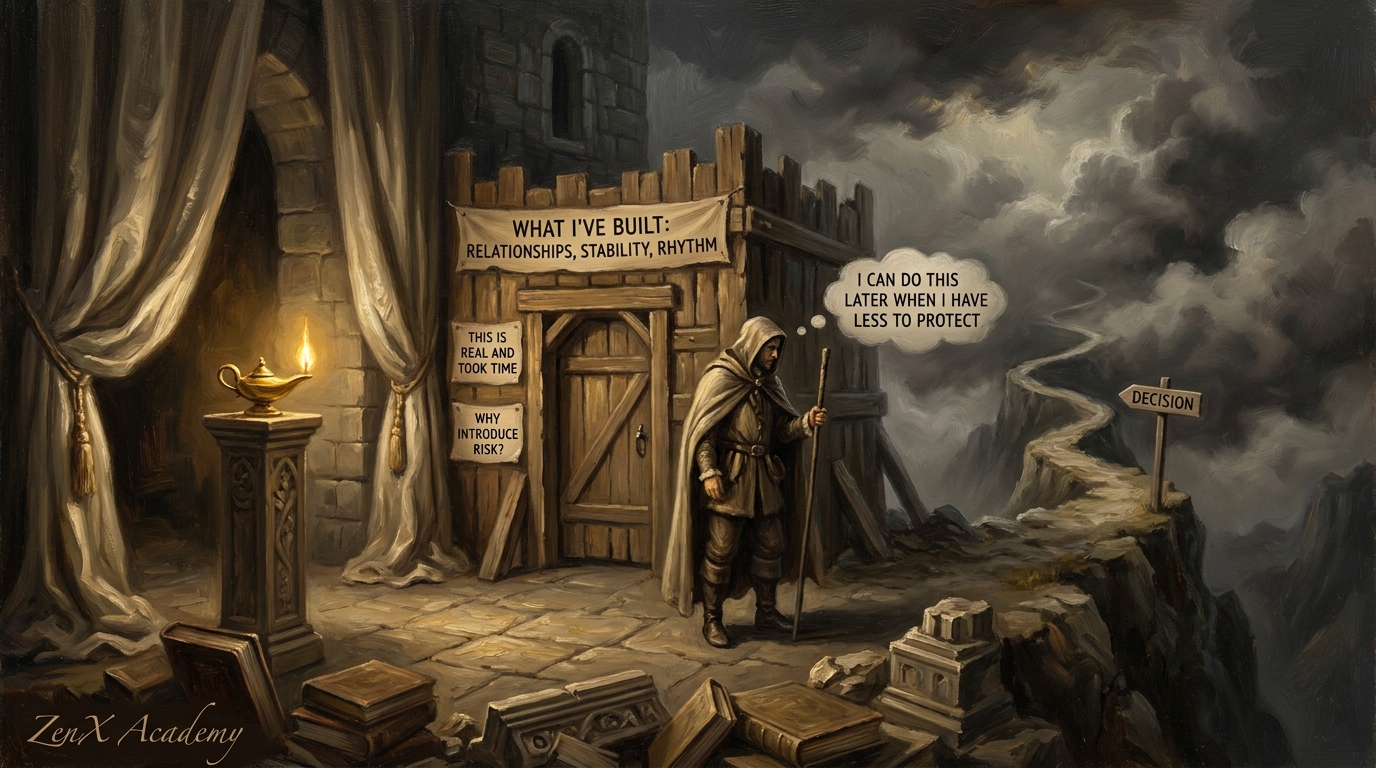
Protect What You Have Built
The arrangement defense
This command does not operate on the decision directly.
It operates on the cost of the decision.
What would change.
What would be disrupted.
What might be lost if the direction were followed.
- "I have built something here that works. Why introduce risk at this point?"
- "The relationships, the stability, the rhythm, this is real and it took time. I should be careful not to disturb it for something uncertain."
- "I can do this later, when I have less to protect."
The command is not wrong that things were built.
They were.
The command is not wrong that change involves risk.
It does.
What the command does not acknowledge:
That the arrangement was built, in part,
around the absence of the decision.
That the stability
is partly the stability of not having moved.
And that protecting it
is partly protecting the house
from the disruption that genuine movement would cause.
Have you said these to yourself?
- "I can't afford to destabilize what I have right now."
- "Once [X] is more settled, I'll have more room for this."
- "It's the wrong time. Too much is happening."
- "I need to protect my energy for what I've already committed to."
I'm Still Figuring This Out
The permanent becoming
This command is the most seductive,
because it uses the language of growth.
- "I'm still in the process of understanding what I actually want."
- "This is all part of figuring out who I am."
- "I don't want to make a major decision before I've done enough inner work."
- "I'm learning a lot right now. This isn't the time to commit to a direction."
These sentences are indistinguishable, in tone,
from the words of a person genuinely engaged in self-development.
They produce the same feeling of movement.
The same texture of engagement.
The same identity of someone working on themselves.
Without requiring
the specific exposure that a real decision would bring.
The Specific Signature
Have you said these to yourself?
- "I need to do more inner work before I'm ready for this."
- "I'm still learning about myself."
- "This isn't the right version yet. I haven't finished figuring it out."
- "I want to come to this from a more integrated place."

What These Commands Share
The gap feeling like wisdom
Read them again.
They are all reasonable.
They all use your vocabulary.
They all contain partial truth.
And they all serve the same function:
They maintain the gap between the clarity
and the point where the clarity would be acted upon.
Not through force.
Not through opposition.
Through the continuous production of language
that makes the gap feel like wisdom.
Before this exercise, a necessary clarification.
Some of these commands are sometimes correct. Sometimes the timing genuinely is wrong. Sometimes the limitation is real and deserves acknowledgment. Sometimes the arrangement truly should be protected. Sometimes the clarity was incomplete.
The work is not learning to distrust every hesitation.
The work is learning to notice when the same language appears repeatedly at the exact threshold where clarity would otherwise become irreversible action.
That pattern of timing is what makes it a command rather than a reflection.
Exercise Six: The Command Examination
The exact words the house uses to maintain itself
Choose the command that operates most actively in you,
the one whose language you recognized most clearly in the examples above.
Write each part:
"My 'not yet' command sounds like:"
(Write the actual sentences you use, not descriptions of them.)
"My 'be realistic' command sounds like:"
(The specific words, in your own voice.)
"My 'protect what I've built' command sounds like:"
"My 'still figuring this out' command sounds like:"
Then read them together.
You are looking at the specific operational language
of your Imra'at Al-Aziz,
the exact words the house uses
to maintain itself.
Now ask one question only:
"Has the clarity I am protecting myself from been present longer than these commands have been running?"
If yes, then the commands have been protecting the house from the clarity. Not the other way around.