 HAMAN · Section Eight
Section Eight
When the Tower Returns
It does not look like failure. It looks like progress.
There is a specific failure mode that appears after the work of this room begins. It does not look like failure. It looks like progress.

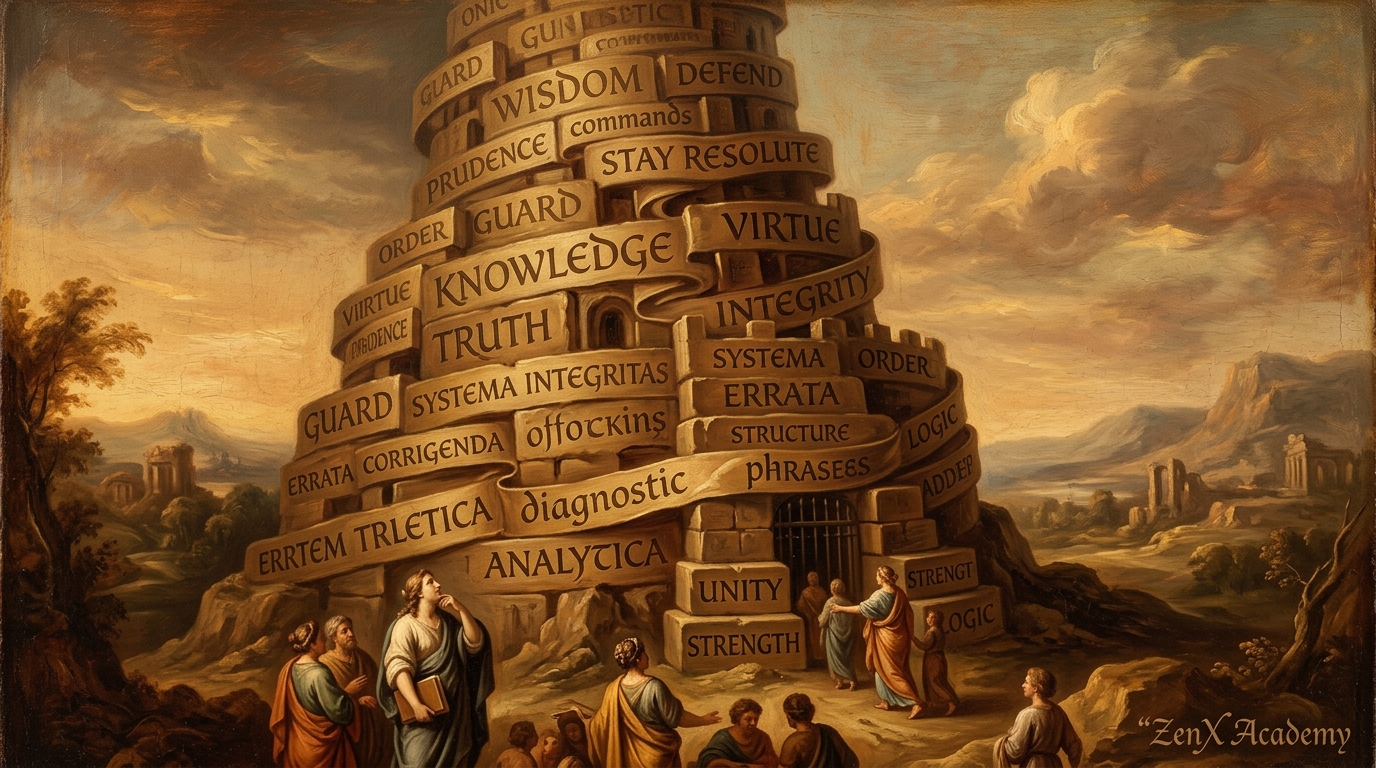
The New Tower
Built from the same materials as the others
Once a person has learned to recognize hidden commands,
to notice the gap, to see the architecture as architecture —
a new structure sometimes begins to form.
It is built from the same materials as the others.
Clay: the genuine ability to now see
what was previously invisible.
Kindling: the idea that this seeing is itself
a foundation that does not need to be examined.
The result is familiar.
A tower that protects the examining function
from being examined.
Commands that sound like:
- "I can see what you're doing."
- "That's just your Haman talking."
- "You're not ready to examine this yet."
- "I've done this work. You haven't."
These are hidden commands.
They have the same structure as every command
this room described.
They arrive before thinking begins.
They carry moral charge.
They redirect away from the foundation.
The foundation, now, being:
the examining function itself.
They have given Haman a new address.
And Haman does not care what story is being protected.
Only that something has become protected from examination.
Principle Zero, Revisited
What was meant at the beginning of the ZenX rooms
This is what was meant, at the beginning of the ZenX rooms,
by Principle Zero:
No examining function earns exemption from examination.
Not as a warning.
As a description of how any serious examining function operates.
The Ibrahim movement does not stop at any particular tower.
It does not exempt the vocabulary of examination.
It does not exempt this room.
A person who has worked through this material
and now uses it to close questions — rather than open them —
has not escaped Haman.

The Diagnostic Question for This Failure Mode
One question to ask
When you find yourself using the language of this room
in a conversation — internally or externally —
ask one question:
Is this language opening examination or closing it?
Not: is this observation accurate?
The observation may be accurate.
The question is whether accuracy is being used
to examine — or to redirect.
A correct diagnosis that functions as a hidden command
is still a hidden command.
What This Does Not Mean
This is not an invitation to infinite regress
This is not an invitation to infinite regress.
It is not asking you to examine
your examination of your examination.
It is pointing to one specific risk:
The vocabulary of any examining system
can be recruited by the thing it was built to examine.
Not through corruption. Not through failure.
Simply through the tower's basic operation:
Sanctified narrative + susceptibility =
structure that makes examination feel like transgression.
The sanctified narrative, now,
is the examining narrative itself.
This is not a reason to distrust the room.
It is a reason to hold the room lightly.

Exercise: The Examining Tower Check
Before closing this section, one question
The Question
In the past week — in any conversation, internal or external —
did you use the language of towers, commands, or architecture
to end a conversation rather than open one?
Not to observe. Not to name something for yourself.
To close.
If Yes
Notice what question was approaching
when the language appeared.
That is sufficient.
The tower's most durable form is the one built around the tools designed to dismantle it.